>
Perciformes/Scorpaenoidei (Scorpionfishes) >
Sebastidae (Rockfishes, rockcods and thornyheads) > Sebastinae
Etymology: Sebastes: Greek, sebastes = august, venerable (Ref. 45335); elongatus: From the Latin elongatus, meaning 'elongate' (Ref. 27436).
More on author: Ayres.
Ambiente: milieu / zona climatica / distribuzione batimetrica / gamma di distribuzione
Ecologia
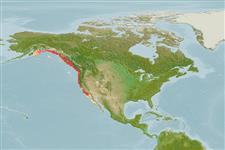
marino demersale; distribuzione batimetrica 25 - 425 m (Ref. 6793), usually 91 - 366 m (Ref. 6885). Temperate; 60°N - 27°N, 156°W - 114°W
Northeast Pacific: Chirikof Island in the Gulf of Alaska to Cedros Island, Baja California, Mexico.
Lunghezza alla prima maturità / Dimensione / Peso / Età
Maturità: Lm 21.0, range 18 - ? cm
Max length : 39.0 cm TL maschio/sesso non determinato; (Ref. 27437); peso massimo pubblicato: 630.00 g (Ref. 40637); Età massima riportata: 54 anni (Ref. 55701)
Breve descrizione
Chiavi di identificazione | Morfologia | Morfometria
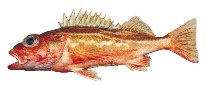
Spine dorsali (totale) : 13; Raggi dorsali molli (totale) : 12 - 14; Spine anali: 3; Raggi anali molli: 6. Head spines strong - nasal, preocular, postocular, tympanic and parietal spines present, supraocular, coronal and nuchal spines absent (Ref. 27437). 2nd anal fin spine long; body slender (Ref. 27437). Pinkish yellow in color, with 3 or 4 horizontal green stripes on body, light ventrally; green streaks on caudal fin membranes (Ref. 27437).
Body shape (shape guide): fusiform / normal.
A common inhabitant of both inshore and offshore areas (Ref. 2850, 6885). Found on rocky as well as soft bottoms (Ref. 2850). Viviparous (Ref. 34817). Only the largest individuals are filleted for human consumption, smaller ones are processed into fishmeal or used as animal feed (Ref. 27436). The flesh has a delicious flavor and appealing texture (Ref. 27436). Rarely caught by sports anglers, but an excellent bait for large lingcod (Ref. 27436). Rare appearances in public aquariums (Ref. 27436).
Lamb, A. and P. Edgell, 1986. Coastal fishes of the Pacific northwest. Madeira Park, (BC, Canada): Harbour Publishing Co. Ltd., 224 p. (Ref. 27436)
Stato della Lista Rossa IUCN (Ref. 130435: Version 2025-2 (Global))
Minaccia per l'uomo
Harmless
Usi umani
Pesca: commerciale; Pesce da pesca sportiva: si; Acquario: Acquari pubblici; esca: usually
Strumenti
Rapporti speciali
Scarica XML
Fonti Internet
Stime basate su modelli
Temperatura preferita (Fonte Biblio.
123201): 5.7 - 8.8, mean 7 °C (based on 73 cells).
Indice di diversità filogenetica (Fonte Biblio.
82804): PD
50 = 0.5000 [Uniqueness, from 0.5 = low to 2.0 = high].
Bayesian length-weight: a=0.01000 (0.00490 - 0.02040), b=3.09 (2.92 - 3.26), in cm total length, based on LWR estimates for this Genus-body shape (Ref.
93245).
Livello trofico (Fonte Biblio.
69278): 3.7 ±0.5 se; based on size and trophs of closest relatives
Generation time: 11.2 ( na - na) years. Estimated as median ln(3)/K based on 2
growth studies.
Resilienza (Fonte Biblio.
120179): Molto basso, tempo minimo di raddoppiamento della popolazione più di 14 anni (tmax=46; tm=9).
Prior r = 0.06, 95% CL = 0.04 - 0.09, Based on 1 full stock assessment.
Vulnerabilità della pesca (Ref.
59153): High vulnerability (63 of 100).
🛈