>
Perciformes/Scorpaenoidei (Scorpionfishes) >
Sebastidae (Rockfishes, rockcods and thornyheads) > Sebastinae
Etymology: Sebastes: Greek, sebastes = august, venerable (Ref. 45335); paucispinis: From the Latin pauci and spinus, connoting 'few' and 'spine' (Ref. 27436).
More on author: Ayres.
Entorno: milieu / zona climática / rango de profundidad / gama de distribución
Ecología
marino asociado a arrecife; rango de profundidad 0 - 476 m (Ref. 27437). Subtropical; 65°N - 31°N
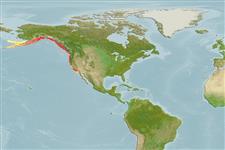
Eastern Pacific: Stepovak Bay, Alaskan Peninsula to Punta Blanca, Baja California, Mexico.
Longitud en la primera madurez / Tamaño / Peso / Edad
Madurez: Lm 48.0, range 36 - ? cm
Max length : 91.0 cm TL macho / no sexado; (Ref. 2850); peso máximo publicado: 9.6 kg (Ref. 4690); edad máxima reportada: 50 años (Ref. 75794)
Descripción breve
Claves de identificación | Morfología | Morfometría
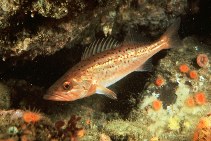
Espinas dorsales (total) : 13 - 15; Radios blandos dorsales (total) : 13 - 16; Espinas anales: 3; Radios blandos anales: 8 - 10; Vértebra: 26. A large rockfish with weak head spines - nasal and parietal spines usually absent, preocular, supraocular, postocular, tympanic, coronal and nuchal spines absent (Ref. 27437). Lower jaw long, thickened, with no real symphyseal knob and projects past upper jaw; maxillary extends to behind the eye; parietal ridges parallel (Ref. 27437). Caudal slightly indented (Ref. 6885). Olive orange to burnt orange or brown in color (Ref. 27437). Branchiostegal rays: 7 (Ref. 36715).
Body shape (shape guide): fusiform / normal.
Adults found over rocky reefs, but also common on open bottoms to about 320 m (Ref. 2850). Juveniles are pelagic and settle in near shore nursery areas, then move to deeper habitats (Ref. 36715). Young form schools (Ref. 2850). Feed mainly on fishes, including other rockfishes (Ref. 2850). Ovoviviparous, with planktonic larvae (Ref. 36715, 6885, 34817). Validated age by radiometry is 37 yrs (Ref. 75794). A famous sport fish throughout its range (Ref. 2850). Flesh is of excellent quality when kept chilled (Ref. 27436). Sold with other rockfish species (Ref. 27436).
Eschmeyer, W.N., E.S. Herald and H. Hammann, 1983. A field guide to Pacific coast fishes of North America. Boston (MA, USA): Houghton Mifflin Company. xii+336 p. (Ref. 2850)
Situación en la Lista Roja de la UICN (Ref. 130435: Version 2025-2 (Global))
Amenaza para el ser humano
Usos humanos
Pesquerías: escaso valor comercial; pesca deportiva: si; Acuario: Acuarios públicos
Herramientas
Informes especiales
Descargar XML
Fuentes de Internet
Estimaciones basadas en modelos
Temperatura preferida (Referencia
123201): 4.5 - 8.9, mean 5.9 °C (based on 177 cells).
Índice de diversidad filogenética (Referencia
82804): PD
50 = 0.5000 [Uniqueness, from 0.5 = low to 2.0 = high].
Bayesian length-weight: a=0.01000 (0.00490 - 0.02040), b=3.09 (2.92 - 3.26), in cm total length, based on LWR estimates for this Genus-body shape (Ref.
93245).
Nivel trófico (Referencia
69278): 3.5 ±0.46 se; based on food items.
Resiliencia (Referencia
120179): Bajo, población duplicada en un tiempo mínimo de 4.5-14 años (tm=4; tmax=50; Musick et al. 2000 (Ref.
36717)).
Prior r = 0.25, 95% CL = 0.17 - 0.38, Based on 2 full stock assessments.
Vulnerabilidad pesquera (Ref.
59153): High vulnerability (63 of 100).
🛈
Vulnerabilidad climática (Ref.
125649): Moderate to high vulnerability (45 of 100).
🛈
Nutrientes (Ref.
124155): Calcium = 11 [4, 34] mg/100g; Iron = 0.34 [0.13, 0.81] mg/100g; Protein = 19.2 [18.0, 20.4] %; Omega3 = 0.4 [0.2, 1.0] g/100g; Selenium = 66.5 [22.9, 204.1] μg/100g; VitaminA = 52.6 [18.2, 150.1] μg/100g; Zinc = 0.446 [0.224, 0.863] mg/100g (wet weight);