>
Perciformes/Scorpaenoidei (Scorpionfishes) >
Sebastidae (Rockfishes, rockcods and thornyheads) > Sebastinae
Etymology: Sebastes: Greek, sebastes = august, venerable (Ref. 45335); pinniger: From the Latin pinna and gero, connoting 'fin' and 'to bear' (Ref. 27436).
More on author: Gill.
Entorno: milieu / zona climática / rango de profundidad / gama de distribución
Ecología
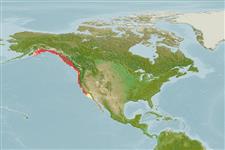
marino demersal; rango de profundidad 0 - 838 m (Ref. 55644), usually 90 - 270 m (Ref. 36715). Subtropical; 5°C - 26°C (Ref. 131079); 61°N - 31°N, 154°W - 116°W
Eastern Pacific: south of the Shelikof Strait in the Gulf of Alaska to Cape Colnett, Baja California, Mexico.
Longitud en la primera madurez / Tamaño / Peso / Edad
Madurez: Lm 44.0, range 27 - 54 cm
Max length : 76.0 cm FL macho / no sexado; (Ref. 3496); peso máximo publicado: 4.5 kg (Ref. 4699); edad máxima reportada: 84 años (Ref. 39247)
Descripción breve
Claves de identificación | Morfología | Morfometría
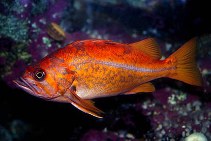
Espinas dorsales (total) : 13; Radios blandos dorsales (total) : 14 - 15; Espinas anales: 3; Radios blandos anales: 7. Head spines strong to moderate - nasal, preocular, supraocular, postocular, tympanic and parietal spines present, coronal and nuchal spines absent (Ref. 27437). Scales on lower jaw embedded; anal fin with a strong anterior slant (Ref. 27437). Caudal fin strongly indented (Ref. 6885). Bright yellow to orange mottled on a gray background; 3 orange stripes across head; fins orange; specimens less than 35.56 cm with dark markings on posterior part of spinous dorsal; gray along lateral line (Ref. 27437).
Body shape (shape guide): fusiform / normal.
Adults hover in loose groups above rocky bottoms (Ref. 27436). Pelagic juveniles are found in shallower water (Ref. 27436). Feed on small fishes and krill (Ref. 2850). Viviparous, with planktonic larvae (Ref. 36715). Validated age by radiometry is 44 yrs (Ref. 49687). Flesh is of good quality (Ref. 27436). Sold as fillets (Ref. 27436).
Ovoviviparous (Ref. 6885).
Eschmeyer, W.N., E.S. Herald and H. Hammann, 1983. A field guide to Pacific coast fishes of North America. Boston (MA, USA): Houghton Mifflin Company. xii+336 p. (Ref. 2850)
Situación en la Lista Roja de la UICN (Ref. 130435: Version 2025-2 (Global))
Amenaza para el ser humano
Usos humanos
Pesquerías: comercial; pesca deportiva: si; Acuario: Acuarios públicos
Herramientas
Informes especiales
Descargar XML
Fuentes de Internet
Estimaciones basadas en modelos
Temperatura preferida (Referencia
123201): 4.7 - 8.3, mean 5.9 °C (based on 144 cells).
Índice de diversidad filogenética (Referencia
82804): PD
50 = 0.5000 [Uniqueness, from 0.5 = low to 2.0 = high].
Bayesian length-weight: a=0.01000 (0.00490 - 0.02040), b=3.09 (2.92 - 3.26), in cm total length, based on LWR estimates for this Genus-body shape (Ref.
93245).
Nivel trófico (Referencia
69278): 3.8 ±0.61 se; based on food items.
Resiliencia (Referencia
120179): Bajo, población duplicada en un tiempo mínimo de 4.5-14 años (tm=7; tmax=84; Musick et al. 2000 (Ref.
36717); Fec=85,000 (annual fecundity)).
Prior r = 0.20, 95% CL = 0.13 - 0.31, Based on 1 full stock assessment.
Vulnerabilidad pesquera (Ref.
59153): High vulnerability (62 of 100).
🛈
Vulnerabilidad climática (Ref.
125649): Moderate to high vulnerability (45 of 100).
🛈
Nutrientes (Ref.
124155): Calcium = 38.1 [11.8, 124.3] mg/100g; Iron = 0.661 [0.265, 1.673] mg/100g; Protein = 18.5 [17.3, 19.6] %; Omega3 = 0.751 [0.329, 1.720] g/100g; Selenium = 106 [39, 337] μg/100g; VitaminA = 15.7 [5.7, 45.8] μg/100g; Zinc = 0.427 [0.216, 0.811] mg/100g (wet weight); based on
nutrient studies.