Окружающая среда: среда / климатическая зона / пределы глубины / диапазон распространения
экология
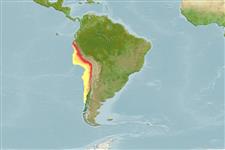
морской pelagic-neritic; мигрирует в океане; пределы глубины 3 - 80 m. Subtropical; 13°C - 23°C (Ref. 6); 5°S - 43°S, 82°W - 69°W (Ref. 54434)
Southeast Pacific: Aguja Point, Peru to Chiloé, Chile (distribution dependent on the coastal extent of the Peru Current).
Длина при первой зрелости / Размер / Вес / Возраст
половая зрелость: Lm 12.0, range 10 - 12.5 cm
Max length : 20.0 cm SL самец/пол неопределен; (Ref. 189); common length : 14.0 cm TL самец/пол неопределен; (Ref. 5504); наибольший возраст (опубликованны данные): 3.00 годы (Ref. 189)
Краткое описание
определительные ключи | морфология | морфометрия
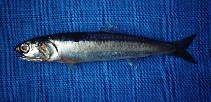
колючие лучи спинного плавника (общее число) : 0; колючие лучи анального плавника: 0. Body elongate, slender, and rounded in cross section; snout long and prominent; lower branch of first gill arch with 34 to 49 gill rakers; anal fin with fewer than 22 rays, located behind dorsal fin base; body shiny blue or green (Ref. 55763). There is a silver stripe along flank in juveniles which disappears with age. The high number of gill rakers distinguishes it from all Pacific species of Anchoa.
Body shape (shape guide): elongated; Cross section: oval.
Adults occur mainly within 80 km of coast, forming huge schools, chiefly in surface waters. Are filter-feeders entirely dependent on the rich plankton of the Peruvian Current. In some studies, diatoms constituted as much as 98% of the diet. Large populations of guano birds and pelicans also depend on this fish (Ref. 9988). Utilized as fish meal and oil (Ref. 9988).
Eggs ellipsoidal.
Whitehead, P.J.P., G.J. Nelson and T. Wongratana, 1988. FAO Species Catalogue. Vol. 7. Clupeoid fishes of the world (Suborder Clupeoidei). An annotated and illustrated catalogue of the herrings, sardines, pilchards, sprats, shads, anchovies and wolf-herrings. FAO Fish. Synop. 125(7/2):305-579. Rome: FAO. (Ref. 189)
Статус Красного Списка МСОП (Ref. 130435: Version 2025-2 (Global))
Угроза для людей
Harmless
Использование человеком
рыболовство: важный объект промысла
дополнительная информация
инструменты
Специальные отчеты
Скачать в формате XML
ресурсы в Интернет
Оценки, основанные на моделях
Предпочтительная температура (ссылка
123201): 17 - 20.8, mean 19.7 °C (based on 10 cells).
Индекс филогенетического разнообразия (ссылка
82804): PD
50 = 0.5020 [Uniqueness, from 0.5 = low to 2.0 = high].
Bayesian length-weight: a=0.00457 (0.00361 - 0.00579), b=3.13 (3.09 - 3.17), in cm total length, based on LWR estimates for this species (Ref.
93245).
Трофический уровень (ссылка
69278): 2.9 ±0.38 se; based on food items.
Generation time: 1.3 (1.1 - 1.3) years. Estimated as median ln(3)/K based on 60
growth studies.
устойчивость к внешним воздействиям (ссылка
120179): высокий, минимальное время удвоения популяции до 15 месяцев (K=0.6-0.9; tm=1; tmax=3; batch fecundity > 10,000).
Prior r = 0.83, 95% CL = 0.54 - 1.24, Based on 3 full stock assessments.
Уязвимость рыбной ловли (Ref.
59153): Low vulnerability (17 of 100).
🛈
Климатическая уязвимость (Ref.
125649): Moderate vulnerability (42 of 100).
🛈
Питательные вещества (Ref.
124155): Calcium = 233 [104, 574] mg/100g; Iron = 1.55 [0.73, 3.65] mg/100g; Protein = 18.7 [17.4, 20.0] %; Omega3 = 0.764 [0.444, 1.331] g/100g; Selenium = 16.8 [7.9, 39.6] μg/100g; VitaminA = 11 [2, 47] μg/100g; Zinc = 1.18 [0.73, 1.89] mg/100g (wet weight);