>
Eupercaria/misc (Various families in series Eupercaria) >
Sciaenidae (Drums or croakers)
Etymology: Cynoscion: Greek, kyon = dog + Greek, odous = teeth + Greek, skion, skiaina = barbel, red mullet (Ref. 45335).
More on author: Cuvier.
Ambiente: milieu / zona climatica / distribuzione batimetrica / gamma di distribuzione
Ecologia
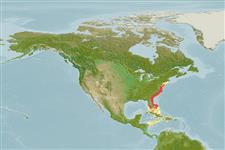
marino; salmastro demersale; non migratori (Ref. 94474); distribuzione batimetrica 10 - ? m (Ref. 9988). Subtropical; 42°N - 15°N, 83°W - 70°W (Ref. 94474)
Western Atlantic: New York to southern Florida in USA and the entire Gulf of Mexico. Northeastern Atlantic: recently reported from Guadalquivir River estuary in Spain (Ref. 94474).
Lunghezza alla prima maturità / Dimensione / Peso / Età
Maturità: Lm 26.8, range 25 - 35 cm
Max length : 100.0 cm TL maschio/sesso non determinato; (Ref. 40637); common length : 36.0 cm TL maschio/sesso non determinato; (Ref. 3702); peso massimo pubblicato: 7.9 kg (Ref. 40637); Età massima riportata: 18 anni (Ref. 12193)
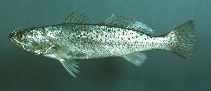
Spine dorsali (totale) : 9 - 11; Raggi dorsali molli (totale) : 25 - 28; Spine anali: 2; Raggi anali molli: 10 - 11. Body silvery, dark grey on back with bluish reflections and numerous round black spots irregularly scattered on upper half, extending to dorsal and caudal fin. Spinous dorsal fin dusky, other fins pale to yellowish. Mouth large, oblique lower jaw projecting. Upper jaw with a pair of large canine-like teeth at tip. Lower jaw with an enlarged inner row of teeth, uniform in size and closely set. Chin without barbels or pores. Snout with 2 marginal pores. Gas bladder with a pair of nearly straight horn-like appendages. Soft portion of dorsal fin unscaled (Ref 51721).
Body shape (shape guide): fusiform / normal.
Inhabits river estuaries and shallow coastal marine waters over sand bottoms, often associated with seagrass beds. Also occurs in salt marshes and tidal pools of high salinity. Feeds mainly on crustaceans and fishes. An important food and sport fish throughout its range. Utilized fresh for steaming, broiling and baking (Ref. 9988).
Robins, C.R. and G.C. Ray, 1986. A field guide to Atlantic coast fishes of North America. Houghton Mifflin Company, Boston, U.S.A. 354 p. (Ref. 7251)
Stato della Lista Rossa IUCN (Ref. 130435: Version 2025-2 (Global))
Minaccia per l'uomo
Harmless
Usi umani
Pesca: commerciale; Pesce da pesca sportiva: si
Strumenti
Rapporti speciali
Scarica XML
Fonti Internet
Stime basate su modelli
Temperatura preferita (Fonte Biblio.
123201): 12 - 26.7, mean 24.3 °C (based on 88 cells).
Indice di diversità filogenetica (Fonte Biblio.
82804): PD
50 = 0.5000 [Uniqueness, from 0.5 = low to 2.0 = high].
Bayesian length-weight: a=0.00832 (0.00511 - 0.01354), b=3.05 (2.92 - 3.18), in cm total length, based on LWR estimates for this species & Genus-body shape (Ref.
93245).
Livello trofico (Fonte Biblio.
69278): 4.0 ±0.66 se; based on food items.
Generation time: 5.8 (4.0 - 6.7) years. Estimated as median ln(3)/K based on 13
growth studies.
Resilienza (Fonte Biblio.
120179): Medio, tempo minimo di raddoppiamento della popolazione 1.4 - 4.4 anni (K=0.2-0.3; tmax=18; tm=1; Fec=1 million).
Prior r = 0.69, 95% CL = 0.46 - 1.04, Based on 1 data-limited stock assessment.
Vulnerabilità della pesca (Ref.
59153): High vulnerability (58 of 100).
🛈
Vulnerabilità climatica (Ref.
125649): High vulnerability (60 of 100).
🛈
Nutrienti (Ref.
124155): Calcium = 43.1 [25.3, 82.0] mg/100g; Iron = 0.771 [0.408, 1.320] mg/100g; Protein = 19.1 [17.7, 20.8] %; Omega3 = 0.33 [0.20, 0.51] g/100g; Selenium = 30.9 [16.5, 56.8] μg/100g; VitaminA = 9.52 [3.34, 29.64] μg/100g; Zinc = 0.667 [0.495, 0.966] mg/100g (wet weight);