>
Perciformes/Cottoidei (Sculpins) >
Cottidae (Sculpins)
Etymology: Clinocottus: Greek, klinein, kline = sloping and bed, due to the four apophyses of sphenoid bone + Greek, kottos = a kind of fish (Ref. 45335).
More on author: Gilbert.
Entorno: milieu / zona climática / rango de profundidad / gama de distribución
Ecología
marino; agua dulce; salobre demersal; rango de profundidad 0 - 20 m (Ref. 96339). Temperate; 66°N - 34°N
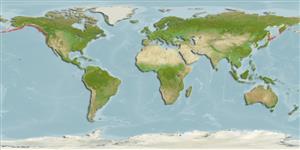
Eastern Pacific: Bering Sea coast of Alaska to Big Sur River, central California, USA.
Tamaño / Peso / Edad
Madurez: Lm ? range ? - ? cm
Max length : 6.4 cm TL macho / no sexado; (Ref. 2850); common length : 4.4 cm TL macho / no sexado; (Ref. 12193)
Descripción breve
Claves de identificación | Morfología | Morfometría
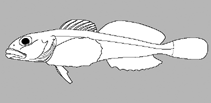
Espinas dorsales (total) : 7 - 9; Radios blandos dorsales (total) : 14 - 16; Espinas anales: 0; Radios blandos anales: 10 - 13; Vértebra: 32 - 33. Distinguished by the flattened tripartite anal papilla and the cirri on the eyeballs, head, lateral line and at the tip of each dorsal spine (Ref. 27547). Gill rakers reduced to low smooth mounds; lateral line high toward the head, curving downward to middle of sides, straight toward the tail, each of the anterior 15 or so pores having a slender cirrus (Ref. 27547). Next to the last anal ray longer than the rays before and behind it; pectorals reach to or just beyond front of anal fin; caudal rounded (Ref. 6885, 27547). Color varies with the environment, sometimes nearly uniform bright green but more often green to light brown above with dark wedge-shaped saddles, broader below, on upper part of sides, with lighter color between; sometimes, along or below lateral line, a dark longitudinal stripe that is in some cases interrupted with light spots; ventral region creamy to white; three dark lines radiating from the eye, the first to the snout, another downward to behind the mouth, the third rearward to base of preopercular spine; spiny dorsal with a dark blotch between first and third spine; pelvic fins plain, others usually dusky, mottled or indistinctly barred (Ref. 27547).
Body shape (shape guide): elongated.
Facultative air-breathing in the genus (Ref. 126274); Commonly found in rocky intertidal and subtidal areas, but also over sand and in eelgrass and seaweeds (Ref. 2850). May leave tide pools if aquatic conditions become inhospitable (Ref. 31184). Occasionally enters fresh water (Ref. 27547). Probably feeds on small invertebrates common among seaweed and in tide pools. Breathes air when out of water (Ref. 31184).
Ciclo vital y comportamiento de apareamiento
Madurez | Reproducción | Puesta | Huevos | Fecundidad | Larva
Eschmeyer, W.N., E.S. Herald and H. Hammann, 1983. A field guide to Pacific coast fishes of North America. Boston (MA, USA): Houghton Mifflin Company. xii+336 p. (Ref. 2850)
Situación en la Lista Roja de la UICN (Ref. 130435: Version 2025-2 (Global))
Amenaza para el ser humano
Harmless
Usos humanos
Pesquerías: sin interés
Herramientas
Informes especiales
Descargar XML
Fuentes de Internet
Estimaciones basadas en modelos
Temperatura preferida (Referencia
123201): 4.6 - 12.8, mean 7.1 °C (based on 597 cells).
Índice de diversidad filogenética (Referencia
82804): PD
50 = 0.5312 [Uniqueness, from 0.5 = low to 2.0 = high].
Bayesian length-weight: a=0.00603 (0.00290 - 0.01252), b=3.14 (2.96 - 3.32), in cm total length, based on LWR estimates for this (Sub)family-body shape (Ref.
93245).
Nivel trófico (Referencia
69278): 3.5 ±0.37 se; based on food items.
Resiliencia (Referencia
120179): Alto, población duplicada en un tiempo mínimo inferior a 15 meses (Preliminary K or Fecundity.).
Vulnerabilidad pesquera (Ref.
59153): Low vulnerability (10 of 100).
🛈