पर्यावरण: पर्यावरण / जलवायु क्षेत्र / गहराई सीमा / वितरण सीमा
पारिस्थितिकी
समुद्री; स्वच्छ जल, अलवण जल; खारा ड़िमरसल; कैटाड़रोमस (Ref. 138280). Temperate; 68°N - 35°N, 175°W - 120°W
North America: Bristol Bay and Aleutian Islands, Alaska to northern California, USA. Isolated populations in lower Kobuk River (Alaska), Cultus Lake (British Columbia, Canada), and Lake Washington (USA) (Ref. 27547).
आकार / वज़न / आयु
परिपक्व अवधि: Lm ? range ? - ? cm
Max length : 17.0 cm TL पुल्लिंग / अलिंग; (Ref. 5723); common length : 6.0 cm TL पुल्लिंग / अलिंग; (Ref. 12193); अधिकतम सूचित उम्र: 8 वर्षो (Ref. 27547)
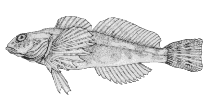
पृष्ठीय रीढ़ (सम्पूर्ण) : 8 - 10; पृष्ठीय सौफट रेज़ (सम्पूर्ण) : 17 - 20; गुदा कांटा: 0; ऐनल सौफट रेज़: 12 - 15; जानवरों की रीड़ का जोड़: 34 - 38. Distinguished by having only a single pore on the tip of the chin, no palatine teeth and no pronounced gap between 1st and 2nd dorsal fins (Ref. 27547). Dark brown to greenish or grayish on back and sides, with darker blotches; sides lighter, ventral areas white; usually two or three dark saddle-like blotches below soft part of dorsal fin; dark bars on dorsal, anal, pectoral and caudal fins; orange edge on spiny dorsal fin of spawning males (Ref. 27547).
Body shape (shape guide): elongated.
Adults inhabit gravel and rubble riffles of medium to large rivers and rocky shores of lakes (Ref. 5723). They occasionally enter estuaries (Ref. 5723) and nearshore coastal water (Ref. 43939). They feed mostly at night and mostly on aquatic insects and benthic invertebrates (Ref. 27547). Generally solitary but large aggregations have been noted (Ref. 27547). Adults make regular seasonal migrations associated with spawning (Ref. 27547). Considered a forage fish for some salmonids (Ref. 1998).
Adults make regular seasonal migrations associated with spawning. They move downstream to estuaries or at least to lower reaches of rivers in the spring, mostly at night (Ref. 27547). Eggs are deposited on the undersurface of a rock, in adhesive masses (Ref. 1998). Over 7,000 eggs have been found in a single nest, suggesting that a male may spawn with several females (Ref. 1998, 27547). The male guards the nest until all eggs have hatched (Ref. 1998, 27547). A reverse, upstream migration of yearlings and adults occur in late summer to early winter, from August to December (Ref. 27547).
Page, L.M. and B.M. Burr, 1991. A field guide to freshwater fishes of North America north of Mexico. Houghton Mifflin Company, Boston. 432 p. (Ref. 5723)
आईयूसीएन रेड लिस्ट स्थिति (Ref. 130435: Version 2025-2 (Global))
मनुष्यों के लिए ख़तरा
Harmless
मानव उपयोग
मात्स्यिकी: कोई रुचि बग़ैर
साधन
विशेष रिपोर्ट
XML डाउनलोड करें
इंटरनेट स्रोत
मॉडल पर आधारित अनुमान
जातिवृति विविधता सूचकांक (संदर्भ
82804): PD
50 = 0.5000 [Uniqueness, from 0.5 = low to 2.0 = high].
Bayesian length-weight: a=0.00832 (0.00345 - 0.02005), b=3.16 (2.98 - 3.34), in cm total length, based on LWR estimates for this Genus-body shape (Ref.
93245).
ट्रॉफिक स्तर (संदर्भ
69278): 3.2 ±0.3 se; based on diet studies.
लौटाव (संदर्भ
120179): माध्यम, न्यूनतम जनसंख्या दुगनी होने का समय 1.4 - 4.4 वर्ष। (tm=3; tmax=8; Fec=100).
मछली पकड़ने की भेद्यता (Ref.
59153): Low vulnerability (10 of 100).
🛈