Umwelt: Milieu / Klimazone / Tiefenbereich / Verbreitungsgebiet
Ökologie
seewasser demersal; tiefenbereich 4 - 320 m (Ref. 50550). Temperate
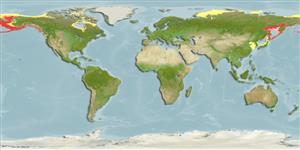
Arctic: Chukchi Sea. North Pacific: Hokkaido, Japan and Sea of Okhotsk and to Buldir Island in the Aleutian chain.
Größe / Gewicht / Alter
Geschlechtsreife: Lm ? range ? - ? cm
Max length : 45.0 cm FL Männchen/unbestimmt; (Ref. 115020)
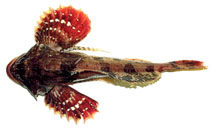
Rückenflossenstacheln (insgesamt) : 11 - 13; Rückenflossenweichstrahlen (insgesamt) : 19 - 20; Afterflossenstacheln: 0; Afterflossenweichstrahlen: 16 - 18. Scales on ventral scale row less than 1/2 the size of those on the dorsal scale row; fin membrane of spiny dorsal well incised; 4 preopercular spines; the 4th simple (Ref. 559).
Body shape (shape guide): elongated.
Lebenszyklus und Paarungsverhalten
Geschlechtsreife | Fortpflanzung | Ablaichen | Eier | Fruchtbarkeit | Larven
Masuda, H., K. Amaoka, C. Araga, T. Uyeno and T. Yoshino, 1984. The fishes of the Japanese Archipelago. Vol. 1. Tokai University Press, Tokyo, Japan. 437 p. (text). (Ref. 559)
IUCN Rote Liste Status (Ref. 130435: Version 2025-2 (Global))
Bedrohung für Menschen
Harmless
Nutzung durch Menschen
Tools
Zusatzinformationen
Download XML
Internet Quellen
Schätzungen auf der Grundlage von Modellen
Bevorzugte Temperatur (Ref.
123201): -1.3 - 5.3, mean 0.9 °C (based on 783 cells).
Phylogenetischer Diversitätsindex (Ref.
82804): PD
50 = 0.5156 [Uniqueness, from 0.5 = low to 2.0 = high].
Bayesian length-weight: a=0.00575 (0.00335 - 0.00989), b=3.09 (2.94 - 3.24), in cm total length, based on LWR estimates for this species & (Sub)family-body (Ref.
93245).
Trophische Ebene (Ref.
69278): 3.5 ±0.54 se; based on food items.
Widerstandsfähigkeit (Ref.
120179): sehr niedrig, Verdopplung der Population dauert mehr als 14 Jahre. (Preliminary K or Fecundity.).
Anfälligkeit der Fischerei (Ref.
59153): Moderate vulnerability (40 of 100).
🛈