>
Perciformes/Cottoidei (Sculpins) >
Agonidae (Poachers) > Brachyopsinae
Etymology: Pallasina: Because of Petrus Simon Pallas, ichthyologist and explorer of Siberia and Asia. He studied the geology, botany and zoology, working in the laboratory of Ichthyology created by Peter the Great. He observed the transit of Venus. Berlin, 1741-1811.
More on author: Steindachner.
Environnement : milieu / zone climatique / profondeur / gamme de distribution
Écologie
marin démersal; profondeur 0 - 105 m (Ref. 50550). Temperate
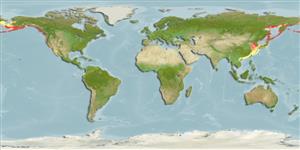
North Pacific: Sea of Japan to the Bering Sea and to Bodega Bay, central California, USA. Past works (e.g. Hart 1973, Ref. 6885) recognized two subspecies, Pallasina barbata barbata occurring in the Bering Sea and along the Asian coast through the Sea of Okhotsk to Japan and Pallasina barbata aix occurring from the Gulf of Alaska to California, USA, as well as Kamchatka and Japan. Sheiko 1993 on the other hand recognizes both Pallasina barbata and Pallasina aix as valid species (Ref. 26282).
Taille / Poids / Âge
Maturité: Lm ? range ? - ? cm
Max length : 17.0 cm TL mâle / non sexé; (Ref. 56557)
Description synthétique
Clés d'identification | Morphologie | Morphométrie
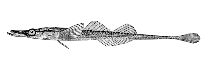
Épines dorsales (Total) : 5 - 8; Rayons mous dorsaux (Total) : 6 - 9; Épines anales: 0; Rayons mous anaux: 8 - 13. Caudal fin rounded (Ref. 28197). Preserved specimens dark brown, darker dorsally, paler ventrally (Ref. 28197). A stripe on head, from tip of snout to, through part between temporal ridge and uppermost preopercular spine, to posterior upper part of opercle (Ref. 28197). Fins pale, except for the dark caudal fin (Ref. 28197). Tiny spots on dorsal and pectoral fin rays (Ref. 28197).
Body shape (shape guide): elongated.
Inhabits intertidal areas and to 55 m depth, possibly to 128 m (Ref. 2850). Often found among eelgrasses or seaweeds (Ref. 2850).
Cycle de vie et comportement reproducteur
Maturité | Reproduction | Frai | Œufs | Fécondité | Larves
Kanayama, T., 1991. Taxonomy and phylogeny of the family Agonidae (Pisces: Scorpaenifomes). Mem. Fac. Fish. Hokkaido Univ. (38)1-2:1-199. (Ref. 28197)
Statut dans la liste rouge de l'IUCN (Ref. 130435: Version 2025-2 (Global))
Menace pour l'homme
Harmless
Utilisations par l'homme
Outils
Articles particuliers
Télécharger en XML
Sources Internet
Estimations basées sur des modèles
Température préférée (Réf.
123201): 1.4 - 14.8, mean 4.2 °C (based on 913 cells).
Indice de diversité phylogénétique (Réf.
82804): PD
50 = 1.0000 [Uniqueness, from 0.5 = low to 2.0 = high].
Bayesian length-weight: a=0.00389 (0.00180 - 0.00842), b=3.12 (2.94 - 3.30), in cm total length, based on all LWR estimates for this body shape (Ref.
93245).
Niveau trophique (Réf.
69278): 3.2 ±0.3 se; based on diet studies.
Résilience (Réf.
120179): Milieu, temps minimum de doublement de population : 1,4 à 4,4 années (Preliminary K or Fecundity.).
Vulnérabilité de la pêche (Ref.
59153): Low vulnerability (10 of 100).
🛈