>
Pleuronectiformes (Flatfishes) >
Paralichthyidae (Large-tooth flounders)
Etymology: Paralichthys: Greek, para = the side of + Greek, ichthys = fish + Greek, suffix, oides = similar to (Ref. 45335).
More on author: Ayres.
Milieu: milieu / Klimaatzone / Diepte / verspreidingsgebied
Ecologie
marien; brak water demersaal; oceanodroom (Ref. 51243); diepte 0 - 183 m (Ref. 2850), usually 0 - 60 m (Ref. 122321). Subtropical; 48°N - 24°N
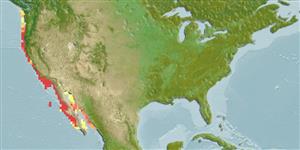
Eastern Pacific: Quillayute River in northern Washington, USA to southern Baja California, Mexico. Also in northern Gulf of California (Ref. 9330).
Lengte bij maturiteit / Grootte / Gewicht / Leeftijd
Maturiteit: Lm 47.3, range 47 - 51.3 cm
Max length : 152 cm TL mannelijk / geslacht onbekend; (Ref. 2850); max. gepubliceerd gewicht: 33.0 kg (Ref. 9330); max. gerapporteerde leeftijd: 30 Jaren (Ref. 33520)
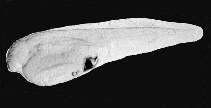
Adults are found mostly on sandy bottoms near shore to 183 m depth. Juveniles are common beyond surf line, larvae settling in bays and estuaries (Ref. 122321). Adults feed during the day (Ref. 9643) on fishes and squids, often well off the bottom. An important sport and commercial fish. They are caught with trammel nets (Ref. 9330). Marketed as fresh fillet (Ref. 9330). Adults migrate to shallower waters to spawn (Ref. 9643). Has very sharp teeth and is known to bite if handled (Ref. 13513).
Distinct pairing (Ref. 205). They are batch spawners that exhibit indeterminate fecundiity and undergo asynchronous ovarian development (Ref. 122336). Spawning interval is between 7 and 14 days while spawning frequency is around 12 to 13 times per year.
Eschmeyer, W.N., E.S. Herald and H. Hammann, 1983. A field guide to Pacific coast fishes of North America. Boston (MA, USA): Houghton Mifflin Company. xii+336 p. (Ref. 2850)
Status op de Rode Lijst van het IUCN (Ref. 130435: Version 2025-2 (Global))
Gevaar voor de mens
Traumatogenic (Ref. 13513)
Gebruik door de mens
Visserij: commercieel; sportvis: ja
Tools
Speciale rapporten
Download XML
Internetbronnen
Schattingen op basis van modellen
Gewenste temperatuur (Ref.
123201): 12.4 - 23.9, mean 19.8 °C (based on 48 cells).
Fylogenetische diversiteitsindex (Ref.
82804): PD
50 = 0.5000 [Uniqueness, from 0.5 = low to 2.0 = high].
Bayesian length-weight: a=0.00661 (0.00404 - 0.01081), b=3.13 (2.99 - 3.27), in cm total length, based on LWR estimates for this species & Genus-body shape (Ref.
93245).
Trofisch niveau (Ref.
69278): 4.5 ±0.63 se; based on food items.
Weerstandsvermogen (Ref.
120179): laag, minimale populatieverdubbelingstijd 4,5-14 jaar (K=0.08; tmax=30; tm=2.6).
Kwetsbaarheid van de visserij (Ref.
59153): Moderate to high vulnerability (55 of 100).
🛈
Kwetsbaarheid voor het klimaat (Ref.
125649): High vulnerability (61 of 100).
🛈
Voedingsstoffen (Ref.
124155): Calcium = 38.8 [16.9, 81.8] mg/100g; Iron = 0.81 [0.38, 1.56] mg/100g; Protein = 17.1 [14.7, 20.3] %; Omega3 = 0.207 [0.112, 0.387] g/100g; Selenium = 40.7 [19.2, 95.9] μg/100g; VitaminA = 5.82 [1.41, 25.97] μg/100g; Zinc = 0.371 [0.244, 0.589] mg/100g (wet weight);