分類 / 名前
共通名の | 類義語 | Catalog of Fishes(部類, 種) | ITIS | CoL | WoRMS | Cloffa
Taxonomic Remarks
Hybridizes with Parophrys vetulus - the hybrid, called Inopsetta ischyra, may be found from the Bering Sea to San Francisco, California, USA (ref. 6885). Also hybridizes with Kareius bicoloratus (Ref. 27547).
環境:環境 / 気候帯 / 深さの範囲 / 分布範囲
生態学
海; 新鮮な水; 汽水性の 底生の; 降流性の (Ref. 126106); 深さの範囲 0 - 375 m (Ref. 6793). Polar; 73°N - 33°N, 124°E - 119°W
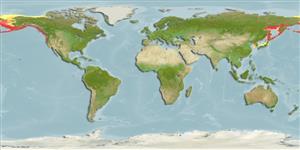
Northern Pacific, from the Yellow Sea along coasts of Korean Peninsula, Russian Far East, and Japanese Arch. to the Arctic, including Chukchi and Beaufort seas, extending to the south through the Bering Sea to California.
初回成熟時の長さ / サイズ / 重さ / 年齢
成熟: Lm ?, range 35 - ? cm
Max length : 91.0 cm TL オス/雌雄の選別がない; (Ref. 2850); common length : 57.5 cm TL オス/雌雄の選別がない; (Ref. 12193); 最大公表体重: 9.1 kg (Ref. 2850); 最大記録サイズ: 42 年 (Ref. 117245)
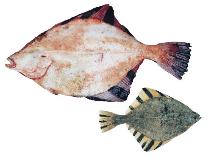
背面の脊椎 (合計) : 0; 背鰭 (合計) : 52 - 66; 肛門の骨: 1; 臀鰭: 38 - 47; 脊つい: 34 - 37. Distinguished by the presence of both eyes on the same side of the head, dorsal and anal fins that are marked with dark and light (white to orange) bars, and especially, by the stellate, bony tubercles scattered over its body (Ref. 27547). Dorsal originates over middle of upper eye; anal with a sharp, forward pointing spine (often buried in skin) before first ray; pectorals are bluntly pointed; caudal slightly rounded (Ref. 27547). Eyed side dark brown to nearly black, sometimes with indefinite blotchings (Alaskans specimens sometimes with a greenish tinge); blind side white to creamy; dorsal fin with 4 to 7 dark bars with white to orange spaces between; anal fin with 4 to 6 such bars; caudal fin with 3 or 4 dark longitudinal bars on its posterior part; in rare cases, the blind side may be partly or completely colored like the eyed side, or white may be present on the eyed side, creating a piebald effect (Ref. 27547, 28897, 28898).
Body shape (shape guide): short and / or deep.
Found inshore, often in very shallow water and in estuaries during the summer; moving into deeper water in the winter (Ref. 27547). However, they may occur in deep water throughout the year (Ref. 27547). They do not venture into water of high salinities (Ref. 28899). Young and adults move up rivers, as much as 120 km (Ref. 27547). Benthic (Ref. 58426). They feed on crustaceans, worms, small mollusks, brittle stars, and small fishes (Ref. 6885). Important game fish (Ref. 2850). Utilized fresh and frozen; eaten steamed, fried, boiled, microwaved, and baked (Ref. 9988).
ライフサイクルと交尾行動
成熟 | 繁殖 | 放精 | 卵 | 生産力 | 幼生
Onset of metamorphosis occurs at 10.5 mm. First settlement of young is in shallow silty-sandy substrates, usually in estuaries (Ref. 117245).
Vinnikov, K.A., R.C. Thomson and T.A. Munroe, 2018. Revised classification of the righteye flounders (Teleostei: Pleuronectidae) based on multilocus phylogeny with complete taxon sampling. Molecular phylogenetics and evolution, 125:147-162. (Ref. 122998)
IUCNのレッドリストの状況は (Ref. 130435: Version 2025-2 (Global))
人間の用途
水産業: 少数商業の; ゲームフィッシュ: はい
用具
特記事項
XMLをダウンロードして下さい
インターネットの情報源
モデルに基づく推定値
好ましい温度 (参照
123201): 0.2 - 8.3, mean 3.2 °C (based on 669 cells).
系統多様性指数 (参照
82804): PD
50 = 0.5625 [Uniqueness, from 0.5 = low to 2.0 = high].
Bayesian length-weight: a=0.00813 (0.00710 - 0.00931), b=3.09 (3.05 - 3.13), in cm total length, based on LWR estimates for this species (Ref.
93245).
栄養段階 (参照
69278): 3.6 ±0.1 se; based on diet studies.
Generation time: 5.7 ( na - na) years. Estimated as median ln(3)/K based on 1
growth studies.
回復力 (参照
120179): 非常に低い, 14年以上の倍増期間の最小個体群 (tm=2-3; tmax=42).
漁業の脆弱性 (Ref.
59153): Moderate to high vulnerability (51 of 100).
🛈
気候脆弱性 (Ref.
125649): High vulnerability (61 of 100).
🛈
栄養素 (Ref.
124155): Calcium = 19.3 [7.6, 34.8] mg/100g; Iron = 0.295 [0.124, 0.633] mg/100g; Protein = 17.3 [15.2, 19.3] %; Omega3 = 0.192 [0.086, 0.415] g/100g; Selenium = 19.4 [7.6, 49.8] μg/100g; VitaminA = 4.35 [0.71, 27.54] μg/100g; Zinc = 0.332 [0.214, 0.514] mg/100g (wet weight); based on
nutrient studies.