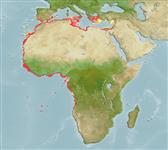
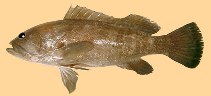
Ambiente: milieu / zona climatica / distribuzione batimetrica / gamma di distribuzione
Ecologia
marino; salmastro demersale; oceanodromo (Ref. 51243); distribuzione batimetrica 20 - 200 m (Ref. 3589). Subtropical; 39°N - 16°S, 17°W - 60°E (Ref. 54435)
Eastern Atlantic: along the west coast of Africa to southern Angola (Ref. 5222, 57293), including the southern Mediterranean (Ref. 5222). First record from Corsica, France in 2012 (Ref. 95840). Records from the Canary Islands and Cape Verde are unsubstantiated (Ref. 5222).
Lunghezza alla prima maturità / Dimensione / Peso / Età
Maturità: Lm 55.0, range 50 - 60 cm
Max length : 120 cm TL maschio/sesso non determinato; (Ref. 5222); common length : 60.0 cm TL maschio/sesso non determinato; (Ref. 26999); peso massimo pubblicato: 25.0 kg (Ref. 5222)
Spine dorsali (totale) : 10 - 11; Raggi dorsali molli (totale) : 14 - 16; Spine anali: 3; Raggi anali molli: 7 - 9. Diagnosis: depth of body less than head length, depth 3.0-3.6 times in SL; head length 2.5-2.9 times in SL; interorbital area convex; preopercle angular, 3.6- large spines at the angle, lowermost directed ventrally; posterior nostril slightly bigger than anterior nostril; maxilla reaches nearly to vertical at rear edge of eye; pelvic fin origin below base of pectoral fins; rounded caudal fin; body scales ctenoid (Ref. 89707).
Body shape (shape guide): fusiform / normal; Cross section: compressed.
Adults are found on rocky or mud-sand bottom; juveniles have been taken in coastal lagoons and estuaries (Ref. 5222, 57293). In the west African waters, diet comprise of fishes (58%), stomatopods (21%), crabs (10%), and cephalopods (10%). It is a protogynous hermaphrodite. The seasonal migration of the species off the coast of Senegal is influenced by the seasonal upwelling off Senegal and Mauritania. Utilized fresh and smoked (Ref. 9987). Highly esteemed in the market of West Africa (Ref. 5377).
Most females change sex at about 9 kg, but smaller males (of 3 to 5 kg) are occasionally found. Total potential fecundity was estimated to range from 789,436 ova in a 44 cm SL fish of 2.2 kg to 12,589,242 ova in a 87 cm SL fish of 12.6 kg. In Tunisia, sex change occurs at 10 to 13 years (6 to 15 kg, 80 to 110 cm TL).
Heemstra, P.C. and J.E. Randall, 1993. FAO Species Catalogue. Vol. 16. Groupers of the world (family Serranidae, subfamily Epinephelinae). An annotated and illustrated catalogue of the grouper, rockcod, hind, coral grouper and lyretail species known to date. Rome: FAO. FAO Fish. Synop. 125(16):382 p. (Ref. 5222)
Stato della Lista Rossa IUCN (Ref. 130435: Version 2025-2 (Global))
Minaccia per l'uomo
Harmless
Usi umani
Pesca: commerciale; Acquacoltura: sperimentale; Pesce da pesca sportiva: si
Strumenti
Rapporti speciali
Scarica XML
Fonti Internet
Stime basate su modelli
Temperatura preferita (Fonte Biblio.
123201): 14.8 - 20.2, mean 17.1 °C (based on 122 cells).
Indice di diversità filogenetica (Fonte Biblio.
82804): PD
50 = 0.5000 [Uniqueness, from 0.5 = low to 2.0 = high].
Bayesian length-weight: a=0.01148 (0.01010 - 0.01305), b=3.04 (3.02 - 3.06), in cm total length, based on LWR estimates for this species (Ref.
93245).
Livello trofico (Fonte Biblio.
69278): 4.0 ±0.59 se; based on food items.
Resilienza (Fonte Biblio.
120179): Medio, tempo minimo di raddoppiamento della popolazione 1.4 - 4.4 anni (K=0.15-0.25; tm=5-7; tmax=17; Fec>1 million).
Vulnerabilità della pesca (Ref.
59153): High vulnerability (58 of 100).
🛈
Vulnerabilità climatica (Ref.
125649): Moderate vulnerability (45 of 100).
🛈
Nutrienti (Ref.
124155): Calcium = 32.2 [14.1, 76.7] mg/100g; Iron = 0.752 [0.370, 1.712] mg/100g; Protein = 18.9 [17.1, 20.5] %; Omega3 = 0.324 [0.182, 0.593] g/100g; Selenium = 37.3 [17.2, 85.4] μg/100g; VitaminA = 17.6 [4.1, 75.8] μg/100g; Zinc = 0.761 [0.487, 1.222] mg/100g (wet weight); based on
nutrient studies.