>
Tetraodontiformes (Puffers and filefishes) >
Monacanthidae (Filefishes)
Etymology: Aluterus: Name from Greek meaning not free or detached, referring to the pelvis that does not form a spiny project (as it does in triggerfish) (R. Chandler, pers. Comm. 10/2014).
More on author: Linnaeus.
Ambiente: milieu / zona climatica / distribuzione batimetrica / gamma di distribuzione
Ecologia
marino associati a barriera corallina; distribuzione batimetrica 1 - 80 m (Ref. 90102). Subtropical; 43°N - 39°S, 180°W - 180°E
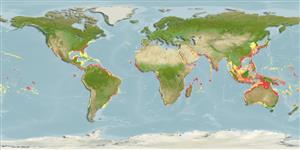
Circumtropical. Western Atlantic: Massachusetts, USA to Argentina (Ref. 36453). Eastern Atlantic: west coast of tropical Africa (Ref. 3592). Eastern Pacific: Guatemala to Chile (Ref. 9068); probably in Mexico (Ref. 9318). Western Indian Ocean: Mozambique and South Africa (Ref. 4421). Recorded from La Reunion (Ref. 53568).
Dimensione / Peso / Età
Maturità: Lm ? range ? - ? cm
Max length : 76.2 cm TL maschio/sesso non determinato; (Ref. 26340); common length : 40.0 cm TL maschio/sesso non determinato; (Ref. 3467); peso massimo pubblicato: 2.7 kg (Ref. 40637)
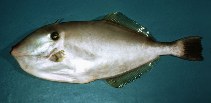
Spine dorsali (totale) : 2; Raggi dorsali molli (totale) : 45 - 52; Spine anali: 0; Raggi anali molli: 47 - 53. Rudimentary pelvic spine disappears in large specimen (Ref. 36453). Snout convex in adults (Ref. 1602). Sandy to grey with small brown spots above; soft dorsal and anal fins pale yellowish to brownish; caudal membrane blackish brown (Ref. 4421).
Body shape (shape guide): short and / or deep.
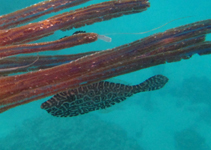
Occasionally in shallow water by steep drop-offs. Solitary or in pairs, occasionally in groups of five or six, at less than 10 m depth. Juveniles are pelagic, seen under floating objects (Ref. 9318, 48637). Benthopelagic (Ref. 58302). Adults and juveniles are rarely seen near reefs. Juveniles often with large jellies and these may bring them close to reefs and adults may nest on sandflats adjacent to reefs in deep water. At other times, the adults may form large schools under weed-rafts that usually form during the wet season (Ref. 48637). Feed on benthic organisms (Ref. 30573).
Ciclo vitale e comportamento di accoppiamento
Maturità | Riproduzione | Deposizione | Uova | Fecondità | Larve
Distinct pairing (Ref. 205).
Harmelin-Vivien, M.L. and J.-C. Quéro, 1990. Monacanthidae. p. 1061-1066. In J.C. Quero, J.C. Hureau, C. Karrer, A. Post and L. Saldanha (eds.) Check-list of the fishes of the eastern tropical Atlantic (CLOFETA). JNICT, Lisbon; SEI, Paris; and UNESCO, Paris. Vol. 2. (Ref. 3592)
Stato della Lista Rossa IUCN (Ref. 130435: Version 2025-2 (Global))
Minaccia per l'uomo
Reports of ciguatera poisoning (Ref. 30911)
Usi umani
Pesca: commerciale; Pesce da pesca sportiva: si
Strumenti
Rapporti speciali
Scarica XML
Fonti Internet
Stime basate su modelli
Temperatura preferita (Fonte Biblio.
123201): 22.8 - 29, mean 27.6 °C (based on 1868 cells).
Indice di diversità filogenetica (Fonte Biblio.
82804): PD
50 = 0.5625 [Uniqueness, from 0.5 = low to 2.0 = high].
Bayesian length-weight: a=0.01905 (0.01192 - 0.03047), b=2.89 (2.75 - 3.03), in cm total length, based on LWR estimates for this species & (Sub)family-body (Ref.
93245).
Livello trofico (Fonte Biblio.
69278): 3.8 ±0.0 se; based on diet studies.
Generation time: 5.0 ( na - na) years. Estimated as median ln(3)/K based on 1
growth studies.
Resilienza (Fonte Biblio.
120179): Medio, tempo minimo di raddoppiamento della popolazione 1.4 - 4.4 anni (Preliminary K or Fecundity.).
Vulnerabilità della pesca (Ref.
59153): Moderate to high vulnerability (48 of 100).
🛈
Nutrienti (Ref.
124155): Calcium = 13.9 [5.6, 53.9] mg/100g; Iron = 0.487 [0.214, 1.238] mg/100g; Protein = 19.3 [17.1, 21.4] %; Omega3 = 0.154 [0.071, 0.304] g/100g; Selenium = 21.9 [8.3, 50.9] μg/100g; VitaminA = 23.4 [6.0, 98.0] μg/100g; Zinc = 0.522 [0.321, 0.882] mg/100g (wet weight);