>
Tetraodontiformes (Puffers and filefishes) >
Monacanthidae (Filefishes)
Etymology: Aluterus: Name from Greek meaning not free or detached, referring to the pelvis that does not form a spiny project (as it does in triggerfish) (R. Chandler, pers. Comm. 10/2014).
Umwelt: Milieu / Klimazone / Tiefenbereich / Verbreitungsgebiet
Ökologie
seewasser riff-verbunden; tiefenbereich 3 - 120 m (Ref. 36484), usually 3 - 20 m (Ref. 40849). Subtropical; 46°N - 30°S, 180°W - 180°E
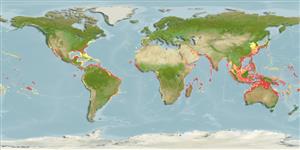
Circumtropical.
Größe / Gewicht / Alter
Geschlechtsreife: Lm ? range ? - ? cm
Max length : 110 cm TL Männchen/unbestimmt; (Ref. 9710); common length : 55.0 cm TL Männchen/unbestimmt; (Ref. 5450); max. veröff. Gewicht: 2.5 kg (Ref. 26340)
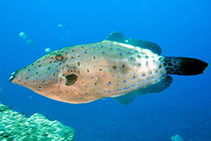
Rückenflossenstacheln (insgesamt) : 2; Rückenflossenweichstrahlen (insgesamt) : 43 - 50; Afterflossenstacheln: 0; Afterflossenweichstrahlen: 46 - 52. Snout concave (Ref. 1602); olive brown to grey in color, juveniles may be yellowish brown with dark spots (Ref. 4421). Elongate, strongly compressed filefish; tan with blue lines and spots. Caudal fin rounded (Ref. 26938) and long (Ref. 13442). Gill opening oblique, pelvic terminus rudimentary or absent; body and head with scattered small black spots (Ref. 13442).
Body shape (shape guide): short and / or deep.
Inhabit lagoon and seaward reefs (Ref. 9710). Occasionally are seen under floating objects (Ref. 1602). Juveniles may travel with weed rafts in open ocean for a long time and reaching a large size. Adults are usually seen along deep coastal slopes or outer reef drop-offs in about 20 meters depth (Ref. 48637). Benthopelagic (Ref. 58302). Feed on algae, seagrass, hydrozoans, gorgonians, colonial anemones, and tunicates. Caught at the surface using a hand net (Ref. 26165).
Lebenszyklus und Paarungsverhalten
Geschlechtsreife | Fortpflanzung | Ablaichen | Eier | Fruchtbarkeit | Larven
Hutchins, J.B., 1986. Monacanthidae. p. 882-887. In M.M. Smith and P.C. Heemstra (eds.) Smiths' sea fishes. Springer-Verlag, Berlin. (Ref. 4421)
IUCN Rote Liste Status (Ref. 130435: Version 2025-2 (Global))
Bedrohung für Menschen
Reports of ciguatera poisoning (Ref. 4690)
Nutzung durch Menschen
Fischereien: kommerziell; Sportfisch: ja; Aquarium: Kommerziell
Tools
Zusatzinformationen
Download XML
Internet Quellen
Schätzungen auf der Grundlage von Modellen
Bevorzugte Temperatur (Ref.
123201): 22.6 - 29, mean 27.4 °C (based on 1766 cells).
Phylogenetischer Diversitätsindex (Ref.
82804): PD
50 = 0.5625 [Uniqueness, from 0.5 = low to 2.0 = high].
Bayesian length-weight: a=0.00933 (0.00538 - 0.01619), b=2.87 (2.72 - 3.02), in cm total length, based on LWR estimates for this species & (Sub)family-body (Ref.
93245).
Trophische Ebene (Ref.
69278): 2.8 ±0.4 se; based on diet studies.
Widerstandsfähigkeit (Ref.
120179): mittel, Verdopplung der Population dauert 1,4 - 4,4 Jahre. (Assuming tm=3-4).
Anfälligkeit der Fischerei (Ref.
59153): High to very high vulnerability (66 of 100).
🛈
Nährstoffe (Ref.
124155): Calcium = 11 [4, 33] mg/100g; Iron = 0.455 [0.208, 1.128] mg/100g; Protein = 18.8 [16.5, 21.0] %; Omega3 = 0.127 [0.055, 0.272] g/100g; Selenium = 28.5 [9.5, 68.4] μg/100g; VitaminA = 18.5 [4.0, 84.0] μg/100g; Zinc = 0.626 [0.387, 1.062] mg/100g (wet weight);