>
Tetraodontiformes (Puffers and filefishes) >
Monacanthidae (Filefishes)
Etymology: Cantherhines: Greek, kanthos = the outer or inner corner of the eye, where the lids meet, 1646 + Greek, rhinos = nose (Ref. 45335).
Umwelt: Milieu / Klimazone / Tiefenbereich / Verbreitungsgebiet
Ökologie
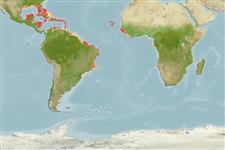
seewasser riff-verbunden; tiefenbereich 2 - 40 m (Ref. 58047), usually 3 - 20 m (Ref. 40849). Tropical; 33°N - 26°S, 99°W - 14°W
Western Atlantic: Florida, USA and Bermuda to São Paulo, Brazil. Eastern Atlantic: St. Paul's Rocks (Ref. 13121).
Größe / Gewicht / Alter
Geschlechtsreife: Lm ? range ? - ? cm
Max length : 46.0 cm TL Männchen/unbestimmt; (Ref. 7251)
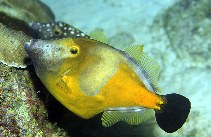
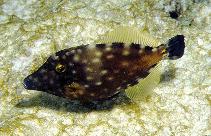
Rückenflossenstacheln (insgesamt) : 2; Rückenflossenweichstrahlen (insgesamt) : 34 - 36; Afterflossenstacheln: 0; Afterflossenweichstrahlen: 29 - 32. Adults are brown, with or without many prominent white spots on body and head; caudal fin black with obscure curved median white bar and two indistinct white basal spots (Ref. 13442). Males are readily distinguished from females of about same size by the larger spines on caudal peduncle and by orange color of patch of setae anterior to the peduncular spines on males (Ref. 13442).
Body shape (shape guide): short and / or deep.
Inhabits coral reefs or rocky bottoms (Ref. 5217). Found among gorgonians. Occurs in pairs (Ref. 5521). Feeds mainly on sponges, gorgonians, and algae (Ref. 9710) but also eats hydroids and stinging coral (Ref. 13442).
Lebenszyklus und Paarungsverhalten
Geschlechtsreife | Fortpflanzung | Ablaichen | Eier | Fruchtbarkeit | Larven
Robins, C.R. and G.C. Ray, 1986. A field guide to Atlantic coast fishes of North America. Houghton Mifflin Company, Boston, U.S.A. 354 p. (Ref. 7251)
IUCN Rote Liste Status (Ref. 130435: Version 2025-2 (Global))
Bedrohung für Menschen
Harmless
Nutzung durch Menschen
Fischereien: kommerziell; Aquarium: Kommerziell
Tools
Zusatzinformationen
Download XML
Internet Quellen
Schätzungen auf der Grundlage von Modellen
Bevorzugte Temperatur (Ref.
123201): 24.9 - 28, mean 27.1 °C (based on 268 cells).
Phylogenetischer Diversitätsindex (Ref.
82804): PD
50 = 0.5002 [Uniqueness, from 0.5 = low to 2.0 = high].
Bayesian length-weight: a=0.02042 (0.01254 - 0.03324), b=2.95 (2.81 - 3.09), in cm total length, based on LWR estimates for this species & (Sub)family-body (Ref.
93245).
Trophische Ebene (Ref.
69278): 3.1 ±0.1 se; based on diet studies.
Widerstandsfähigkeit (Ref.
120179): mittel, Verdopplung der Population dauert 1,4 - 4,4 Jahre. (Preliminary K or Fecundity.).
Anfälligkeit der Fischerei (Ref.
59153): Moderate vulnerability (36 of 100).
🛈
Nährstoffe (Ref.
124155): Calcium = 22.3 [6.6, 67.0] mg/100g; Iron = 0.715 [0.250, 1.955] mg/100g; Protein = 18.2 [16.0, 20.3] %; Omega3 = 0.0721 [, ] g/100g; Selenium = 47.6 [18.4, 133.5] μg/100g; VitaminA = 49.5 [13.6, 175.9] μg/100g; Zinc = 1.55 [0.70, 2.75] mg/100g (wet weight);