>
Gobiiformes (Gobies) >
Gobiidae (Gobies) > Gobiinae
Etymology: Istigobius: Greek, istios = sail + Latin, gobius = gudgeon (Ref. 45335).
More on author: Rüppell.
Environnement : milieu / zone climatique / profondeur / gamme de distribution
Écologie
marin; saumâtre récifal; profondeur 0 - 5 m (Ref. 86942). Tropical; 21°C - 29°C (Ref. 27115); 30°N - 25°S
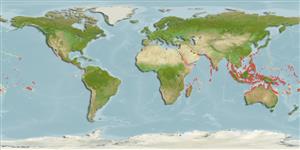
Indo-Pacific: Red Sea south to northern Mozambique (Ref. 4343) and east to Fiji, north to southern Taiwan, south to New Caledonia. Recently recorded from Tonga (Ref. 53797).
Taille / Poids / Âge
Maturité: Lm ? range ? - ? cm
Max length : 11.0 cm TL mâle / non sexé; (Ref. 9710)
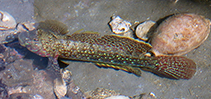
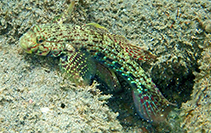
Épines dorsales (Total) : 7; Rayons mous dorsaux (Total) : 10 - 12; Épines anales: 1; Rayons mous anaux: 9 - 11; Vertèbres: 26. Upper 3-4 pectoral fin rays free. Body color pale gray; operculum with 5 small blue spots interspersed with brownish red spots; 5 vertical rows of white spots on pectoral fins; anterior tip of first dorsal fin bright yellow. 4th spine of 1st dorsal fin longest. Predorsal scales cycloid, trunk ctenoid. Mouth with overhanging snout, lips greatly thickened. Cheeks and operculae without scales. Female pelvic and anal fins not as darkly pigmented as in male. Also with terete body shape, slightly depressed; eyes situated dorso-laterally; reduced swim bladders (Ref. 92840).
Body shape (shape guide): fusiform / normal; Cross section: circular.
A common species that inhabits mangroves and silty, rocky areas; occasionally found in rubble reef areas. Only single individuals were observed; many individuals found scattered over a small area (Ref. 420). Found primarily in lower estuaries, usually in mangroves. This is the species of the genus that is found farthest inland. Feeds on small invertebrates (Ref. 12693).
Cycle de vie et comportement reproducteur
Maturité | Reproduction | Frai | Œufs | Fécondité | Larves
Genital papilla, of male varying from lightly to heavily pigmented and terminating to side of anal spine. Female genital papilla lightly pigmented and truncate, terminating well before anal spine (Ref. 420). Benthic spawner (Ref. 32023).
Murdy, E.O. and D.F. Hoese, 1985. Revision of the gobiid fish genus Istigobius. Indo-Pac. Fish. (4):41 p. (Ref. 420)
Statut dans la liste rouge de l'IUCN (Ref. 130435: Version 2025-2 (Global))
Menace pour l'homme
Harmless
Utilisations par l'homme
Pêcheries: commercial; Aquarium: Commercial
Outils
Articles particuliers
Télécharger en XML
Sources Internet
Estimations basées sur des modèles
Température préférée (Réf.
123201): 25.5 - 29.3, mean 28.5 °C (based on 3131 cells).
Indice de diversité phylogénétique (Réf.
82804): PD
50 = 0.5005 [Uniqueness, from 0.5 = low to 2.0 = high].
Bayesian length-weight: a=0.01096 (0.00647 - 0.01859), b=3.04 (2.89 - 3.19), in cm total length, based on LWR estimates for this species & (Sub)family-body (Ref.
93245).
Niveau trophique (Réf.
69278): 4.3 ±0.26 se; based on food items.
Résilience (Réf.
120179): Haut, temps minimum de doublement de population inférieur à 15 mois (Preliminary K or Fecundity.).
Vulnérabilité de la pêche (Ref.
59153): Low vulnerability (10 of 100).
🛈
Nutriments (Ref.
124155): Calcium = 117 [60, 247] mg/100g; Iron = 0.778 [0.388, 1.423] mg/100g; Protein = 18.9 [17.0, 20.6] %; Omega3 = 0.138 [0.061, 0.267] g/100g; Selenium = 14.6 [7.1, 31.0] μg/100g; VitaminA = 134 [36, 471] μg/100g; Zinc = 2.17 [1.43, 3.24] mg/100g (wet weight);