>
Gobiiformes (Gobies) >
Gobiidae (Gobies) > Gobiinae
Etymology: Istigobius: Greek, istios = sail + Latin, gobius = gudgeon (Ref. 45335).
More on author: Herre.
Environnement : milieu / zone climatique / profondeur / gamme de distribution
Écologie
marin récifal; profondeur 1 - 25 m (Ref. 90102), usually 1 - 18 m (Ref. 27115). Tropical; 23°C - 29°C (Ref. 27115); 30°N - 40°S
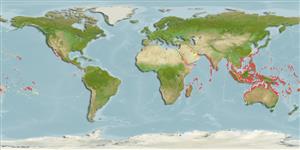
Indo-West Pacific: Persian Gulf (Ref.80050) and Red Sea to Samoa, north to Taiwan, south to Lord Howe Island.
Taille / Poids / Âge
Maturité: Lm ? range ? - ? cm
Max length : 13.0 cm TL mâle / non sexé; (Ref. 2798)
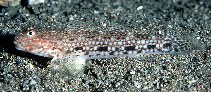
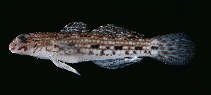
Épines dorsales (Total) : 7; Rayons mous dorsaux (Total) : 10 - 11; Épines anales: 1; Rayons mous anaux: 9 - 11; Vertèbres: 26. Color highly variable, brownish on upper half, grading to white below; dark brown scale margins forming honeycomb pattern and midlateral row of double dark brown spots forming rectangular markings (Ref. 90102); segmented and non branching caudal rays 3 (rarely 2), branching 14 (rarely 15). Predorsal cycloid scales 7-10, trunk ctenoid. Few with no black spots on nape. Isthmus narrow, scaled forward to vertical at posterior part of preoperculum. 2 diagonal, dusky lines on operculum; an inverted U-shaped spot prominent at the distal end of upper jaw. Pectoral fin with small dusky spots; 2 longitudinal lines on pectoral base spreading onto it fin rays. Sexual dimorphism exhibited in anal, pelvic and 2nd dorsal fin (Ref. 420).
Body shape (shape guide): fusiform / normal; Cross section: circular.
A common species that inhabits areas of coralline sand of clear lagoon and seaward reefs (Ref. 9710, 48637). Found singly. Minimum depth from Ref. 58018.
Cycle de vie et comportement reproducteur
Maturité | Reproduction | Frai | Œufs | Fécondité | Larves
Genital papilla of male sometimes darkly pigmented and reaching to side of anal spine. Female genital papilla truncate, ending well before origin of anal fin.
Murdy, E.O. and D.F. Hoese, 1985. Revision of the gobiid fish genus Istigobius. Indo-Pac. Fish. (4):41 p. (Ref. 420)
Statut dans la liste rouge de l'IUCN (Ref. 130435: Version 2025-2 (Global))
Menace pour l'homme
Harmless
Utilisations par l'homme
Pêcheries: commercial; Aquarium: Commercial
Outils
Articles particuliers
Télécharger en XML
Sources Internet
Estimations basées sur des modèles
Température préférée (Réf.
123201): 24.6 - 29.3, mean 28.3 °C (based on 3616 cells).
Indice de diversité phylogénétique (Réf.
82804): PD
50 = 0.5005 [Uniqueness, from 0.5 = low to 2.0 = high].
Bayesian length-weight: a=0.00891 (0.00538 - 0.01477), b=2.92 (2.78 - 3.06), in cm total length, based on LWR estimates for this species & (Sub)family-body (Ref.
93245).
Niveau trophique (Réf.
69278): 3.4 ±0.4 se; based on size and trophs of closest relatives
Résilience (Réf.
120179): Haut, temps minimum de doublement de population inférieur à 15 mois (Preliminary K or Fecundity.).
Vulnérabilité de la pêche (Ref.
59153): Low vulnerability (10 of 100).
🛈
Nutriments (Ref.
124155): Calcium = 99 [54, 188] mg/100g; Iron = 0.755 [0.401, 1.346] mg/100g; Protein = 18.5 [16.6, 20.1] %; Omega3 = 0.142 [0.068, 0.236] g/100g; Selenium = 22.5 [12.7, 41.7] μg/100g; VitaminA = 122 [35, 365] μg/100g; Zinc = 1.79 [1.24, 2.60] mg/100g (wet weight);