>
Ovalentaria/misc (Various families in series Ovalentaria) >
Pomacentridae (Damselfishes) > Microspathodontinae
Etymology: Stegastes: Greek, stegastos, -e, -on = covered (Ref. 45335).
More on authors: Schlegel & Müller.
Milieu: milieu / Klimaatzone / Diepte / verspreidingsgebied
Ecologie
marien rifbewoner; standvastig; diepte 0 - 4 m (Ref. 1602). Tropical; 35°N - 35°S
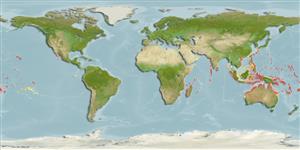
Indo-Pacific: Seychelles and Reunion to the Line and Tuamoto islands, north to the Ryukyu Islands, south to New Caledonia.
Grootte / Gewicht / Leeftijd
Maturiteit: Lm ? range ? - ? cm
Max length : 13.0 cm TL mannelijk / geslacht onbekend; (Ref. 9710)
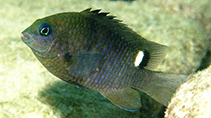
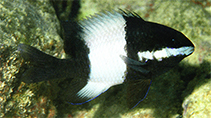
Dorsale stekels (totaal) : 12; Dorsale zachte stralen (totaal) : 15 - 16; Anale stekels: 2; Anale zachte stralen: 12 - 14. Diagnosis: Body dark brown to blackish; suborbital mostly blue with blue spots on side of head; most scales on side of body with blue transverse streak. Fins dark brown to blackish except pectorals which are translucent with dusky rays. Pectorals with scaly inner base and has pupil-sized black spot at the base of uppermost rays; a black spot (maybe bordered anteriorly with white) at base of posterior dorsal rays, slightly extending onto dorsal edge of caudal peduncle; with or without white bar across posterior half of body (Ref. 510). Body depth 1.8-2.1 in SL (Ref. 90102).
Body shape (shape guide): short and / or deep; Cross section: oval.
A territorial herbivore. Adults inhabit reef flats, shallow lagoons, and semi-sheltered reef margins; common among patches of rubble or porous reef rock, surrounded by live coral, particularly in areas of mild surge (Ref. 1602). Also in high energy zones with mixed corals and short algae. They occur in small loose aggregations (Ref. 48636). Feeds on filamentous algae (Ref. 89972). Oviparous, distinct pairing during breeding (Ref. 205). Eggs are demersal and adhere to the substrate (Ref. 205). Males guard and aerate the eggs (Ref. 205).
Levenscyclus en paargedrag
Maturiteit | Voortplanting | Paaien | Eieren | Fecunditeit | Larven
Oviparous, distinct pairing during breeding (Ref. 205). Eggs are demersal and adhere to the substrate (Ref. 205). Males guard and aerate the eggs (Ref. 205).
Allen, G.R. and A.R. Emery, 1985. A review of the Pomacentrid fishes of the genus Stegastes from the Indo-Pacific, with descriptions of two new species. Indo-Pac. Fish. (3):31. (Ref. 510)
Status op de Rode Lijst van het IUCN (Ref. 130435: Version 2025-2 (Global))
Gevaar voor de mens
Harmless
Gebruik door de mens
Tools
Speciale rapporten
Download XML
Internetbronnen
Schattingen op basis van modellen
Gewenste temperatuur (Ref.
123201): 25.1 - 29.3, mean 28.3 °C (based on 2041 cells).
Fylogenetische diversiteitsindex (Ref.
82804): PD
50 = 0.5000 [Uniqueness, from 0.5 = low to 2.0 = high].
Bayesian length-weight: a=0.02042 (0.01001 - 0.04166), b=2.98 (2.81 - 3.15), in cm total length, based on LWR estimates for this species & Genus-body shape (Ref.
93245).
Trofisch niveau (Ref.
69278): 2.0 ±0.00 se; based on food items.
Weerstandsvermogen (Ref.
120179): Hoog, minimale populatieverdubbelingstijd minder dan 15 maanden (Preliminary K or Fecundity.).
Kwetsbaarheid van de visserij (Ref.
59153): Low vulnerability (10 of 100).
🛈
Voedingsstoffen (Ref.
124155): Calcium = 117 [58, 198] mg/100g; Iron = 0.78 [0.46, 1.38] mg/100g; Protein = 18.1 [16.8, 19.3] %; Omega3 = 0.0839 [, ] g/100g; Selenium = 17.3 [8.9, 37.0] μg/100g; VitaminA = 76.1 [17.7, 308.1] μg/100g; Zinc = 2.06 [1.33, 3.18] mg/100g (wet weight);