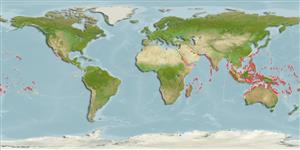
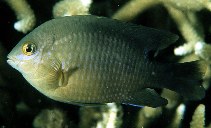
Ambiente: milieu / zona climatica / distribuzione batimetrica / gamma di distribuzione
Ecologia
marino associati a barriera corallina; non migratori; distribuzione batimetrica 1 - 12 m (Ref. 7247). Tropical; 30°N - 30°S
Indo-Pacific: Red Sea and East Africa to the Line, Marquesas, and Tuamoto islands, north to the Ryukyu and Bonin islands, south to New Caledonia and Tonga; throughout Micronesia. Excluding the Hawaiian Islands (Ref. 7247). Hawaiian population refers to Stegastes marginatus (Ref. 86689).
Dimensione / Peso / Età
Maturità: Lm ? range ? - ? cm
Max length : 14.0 cm TL maschio/sesso non determinato; (Ref. 4391); common length : 9.0 cm TL maschio/sesso non determinato; (Ref. 5450)
Spine dorsali (totale) : 12; Raggi dorsali molli (totale) : 15 - 17; Spine anali: 2; Raggi anali molli: 12 - 14. Diagnosis: Adults generally brown; dorsal part of head and nape darker, grading to tan on lower part of head and breast. The scales have darker brown margins. The lips are whitish lips; the suborbital is mostly blue; the preopercle and opercle scales with blue centers. The median and pelvic fins are brown; the pectorals are dusky; a well-defined dark brown or blackish spot is sometimes present at base of posteriormost dorsal rays, which distinguishes it from S. lividus where the spot is diffuse. Males in courtship or guarding eggs with broad white bar across middle of body and pale blue stripe from mouth to upper part of pectoral fin (Ref. 510).
Body shape (shape guide): short and / or deep; Cross section: oval.
Adults inhabit reef flats and lagoon reefs. Frequently occur in colonies associated with live or dead branching staghorn coral (Acropora). Feed on algae, gastropods, sponges, and copepods. Territorial, maintain and 'weed' filamentous algae patches growing on dead coral (Ref. 9710). They attack human intruders without hesitation, sometimes taking painful nips. Particularly aggressive during reproductive periods. The species emit clicking noises during aggressive encounters. Oviparous, males tend the nest visited by several females (Ref. 59295).
Ciclo vitale e comportamento di accoppiamento
Maturità | Riproduzione | Deposizione | Uova | Fecondità | Larve
Oviparous, distinct pairing during breeding (Ref. 205). Eggs are demersal and adhere to the substrate (Ref. 205). Males guard and aerate the eggs (Ref. 205).
Allen, G.R. and A.R. Emery, 1985. A review of the Pomacentrid fishes of the genus Stegastes from the Indo-Pacific, with descriptions of two new species. Indo-Pac. Fish. (3):31. (Ref. 510)
Stato della Lista Rossa IUCN (Ref. 130435: Version 2025-2 (Global))
Usi umani
Pesca: scarso interesse commerciale; Acquario: Acquari pubblici
Strumenti
Rapporti speciali
Scarica XML
Fonti Internet
Stime basate su modelli
Temperatura preferita (Fonte Biblio.
123201): 25 - 29.3, mean 28.4 °C (based on 3006 cells).
Indice di diversità filogenetica (Fonte Biblio.
82804): PD
50 = 0.5000 [Uniqueness, from 0.5 = low to 2.0 = high].
Bayesian length-weight: a=0.02399 (0.01454 - 0.03959), b=3.02 (2.88 - 3.16), in cm total length, based on LWR estimates for this species & Genus-body shape (Ref.
93245).
Livello trofico (Fonte Biblio.
69278): 2.2 ±0.0 se; based on diet studies.
Generation time: 1.9 ( na - na) years. Estimated as median ln(3)/K based on 2
growth studies.
Resilienza (Fonte Biblio.
120179): Alto, tempo minimo di raddoppiamento della popolazione meno di 15 mesi (K=0.5-1.1).
Vulnerabilità della pesca (Ref.
59153): Low vulnerability (13 of 100).
🛈
Nutrienti (Ref.
124155): Calcium = 130 [67, 211] mg/100g; Iron = 0.938 [0.553, 1.586] mg/100g; Protein = 18.2 [17.0, 19.4] %; Omega3 = 0.0973 [, ] g/100g; Selenium = 27.5 [14.6, 56.1] μg/100g; VitaminA = 45 [11, 168] μg/100g; Zinc = 1.96 [1.29, 2.92] mg/100g (wet weight);