>
Eupercaria/misc (Various families in series Eupercaria) >
Labridae (Wrasses) > Scarinae
Etymology: Calotomus: Greek, kalos, kallos = beautiful + Greek, tomos = section, cut (Ref. 45335).
More on author: Valenciennes.
Ambiente: milieu / zona climatica / distribuzione batimetrica / gamma di distribuzione
Ecologia
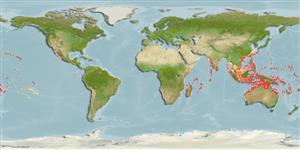
marino associati a barriera corallina; distribuzione batimetrica 1 - 71 m (Ref. 58302). Tropical; 30°N - 31°S, 30°E - 89°W
Indo-Pacific and Eastern Pacific: widest ranging member of the genus, from East Africa to the Revillagigedo and Galapagos islands. Replaced by Calotomus viridescens in the Red Sea (Ref. 37816). Presence in Somalia to be confirmed (Ref. 30573).
Dimensione / Peso / Età
Maturità: Lm ? range ? - ? cm
Max length : 54.0 cm TL maschio/sesso non determinato; (Ref. 5490)
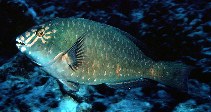
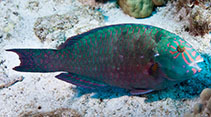
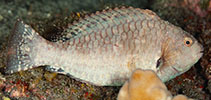
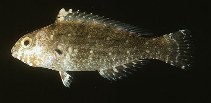
Spine dorsali (totale) : 9; Raggi dorsali molli (totale) : 10; Spine anali: 3; Raggi anali molli: 9; Vertebre: 25. Grayish brown when fresh with scales with fine whitish markings, shading to brownish red ventrally; head paler ventrally, an indistinct orange-brown line from orbit to upper lip; posterior to orbit, 3 short dull reddish lines. Flexible dorsal spines. Caudal fin rounded in juveniles, double emarginate with slightly prolonged lobes in large males. Skin black around anus. Lateral line interrupted. Brownish red pelvic fins with blotches or spots. Dull reddish-brown iris.
Body shape (shape guide): fusiform / normal; Cross section: compressed.
Inhabits subtidal reef flats, and lagoon and seaward reefs to a depths of at least 27 m (Ref. 1602). Found in coral, rubble, seagrass (Ref. 41878, 58302) and weedy areas (Ref. 9710). Benthopelagic (Ref. 58302). Found singly or in small groups (Ref. 9710). Feeds on a variety of benthic encrusting algae, e.g., Padina (Ref. 37816) and seagrasses. A protogynous hermaphrodite which may only have secondary males. Caught with nets and other types of artisanal gear.
Ciclo vitale e comportamento di accoppiamento
Maturità | Riproduzione | Deposizione | Uova | Fecondità | Larve
Spawning observed to occur off the reef front on the falling tide at the Aldabra Atoll.
Bruce, R.W. and J.E. Randall, 1985. A revision of the Indo-West Pacific parrotfish genera Calotomus and Leptoscarus (Scaridae: Sparisomatinae). Indo-Pac. Fish. (5):32 p. (Ref. 525)
Stato della Lista Rossa IUCN (Ref. 130435: Version 2025-2 (Global))
Minaccia per l'uomo
Harmless
Usi umani
Pesca: commerciale; Acquario: Commerciale
Strumenti
Rapporti speciali
Scarica XML
Fonti Internet
Stime basate su modelli
Temperatura preferita (Fonte Biblio.
123201): 24.7 - 28.7, mean 27.5 °C (based on 664 cells).
Indice di diversità filogenetica (Fonte Biblio.
82804): PD
50 = 0.5312 [Uniqueness, from 0.5 = low to 2.0 = high].
Bayesian length-weight: a=0.01380 (0.01178 - 0.01617), b=3.06 (3.02 - 3.10), in cm total length, based on LWR estimates for this species (Ref.
93245).
Livello trofico (Fonte Biblio.
69278): 2.0 ±0.00 se; based on food items.
Resilienza (Fonte Biblio.
120179): Medio, tempo minimo di raddoppiamento della popolazione 1.4 - 4.4 anni (Preliminary K or Fecundity.).
Vulnerabilità della pesca (Ref.
59153): Moderate vulnerability (42 of 100).
🛈
Nutrienti (Ref.
124155): Calcium = 32.7 [16.7, 106.5] mg/100g; Iron = 0.707 [0.295, 1.658] mg/100g; Protein = 18.8 [16.7, 20.6] %; Omega3 = 0.0819 [, ] g/100g; Selenium = 21.7 [7.4, 57.5] μg/100g; VitaminA = 25.7 [7.3, 94.8] μg/100g; Zinc = 1.96 [0.97, 3.40] mg/100g (wet weight); based on
nutrient studies.