>
Eupercaria/misc (Various families in series Eupercaria) >
Sparidae (Porgies)
Etymology: Pagellus: Diminutive of Latin, pager, derived from Greek, pagros = a fish, Dentex sp. (Ref. 45335).
Eponymy: Cristoforo Bellotti (1823–1919) was an Italian ichthyologist and palaeontologist, who was also very interested in the breeding of silkworms. [...] (Ref. 128868), visit book page.
More on author: Steindachner.
Environnement : milieu / zone climatique / profondeur / gamme de distribution
Écologie
marin démersal; profondeur 100 - 250 m (Ref. 27000), usually 10 - 50 m (Ref. 5377). Subtropical; 37°N - 17°S, 19°W - 14°E
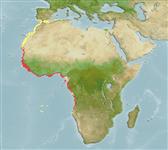
Eastern Atlantic: Strait of Gibraltar to Angola, including the southwestern Mediterranean (Ref. 3469) and the Canary Islands.
Longueur à la première maturité / Taille / Poids / Âge
Maturité: Lm 12.2 range ? - ? cm
Max length : 42.0 cm SL mâle / non sexé; (Ref. 4781); common length : 25.0 cm SL mâle / non sexé; (Ref. 4781)
Description synthétique
Clés d'identification | Morphologie | Morphométrie
Épines dorsales (Total) : 12.
Body shape (shape guide): fusiform / normal.
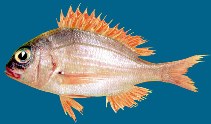
Occurs in schools over hard as well as sandy bottoms, especially in the upper 100 m. Omnivorous with a predominantly carnivorous diet (including crustaceans, cephalopods, small fish, amphioxus and worms). Protogynic hermaphrodite (Ref. 3688). Minimum depth reported taken from Ref. 127989.
Cycle de vie et comportement reproducteur
Maturité | Reproduction | Frai | Œufs | Fécondité | Larves
Intermittent spawning occurs from the second year onwards between May and November according to the latitude, the stock moving toward the coast for this purpose.
Bauchot, M.-L. and J.-C. Hureau, 1990. Sparidae. p. 790-812. In J.C. Quero, J.C. Hureau, C. Karrer, A. Post and L. Saldanha (eds.) Check-list of the fishes of the eastern tropical Atlantic (CLOFETA). JNICT, Lisbon; SEI, Paris; and UNESCO, Paris. Vol. 2. (Ref. 3688)
Statut dans la liste rouge de l'IUCN (Ref. 130435: Version 2025-2 (Global))
Menace pour l'homme
Harmless
Utilisations par l'homme
Pêcheries: commercial
Outils
Articles particuliers
Télécharger en XML
Sources Internet
Estimations basées sur des modèles
Température préférée (Réf.
123201): 18.5 - 28, mean 25.2 °C (based on 140 cells).
Indice de diversité phylogénétique (Réf.
82804): PD
50 = 0.5156 [Uniqueness, from 0.5 = low to 2.0 = high].
Bayesian length-weight: a=0.01202 (0.00991 - 0.01458), b=3.03 (3.00 - 3.06), in cm total length, based on LWR estimates for this species (Ref.
93245).
Niveau trophique (Réf.
69278): 4.0 ±0.51 se; based on food items.
Generation time: 4.6 (2.5 - 6.1) years. Estimated as median ln(3)/K based on 10
growth studies.
Résilience (Réf.
120179): Milieu, temps minimum de doublement de population : 1,4 à 4,4 années (K=0.18-0.53; tm=1; tmax=7; Fec=60,200).
Prior r = 0.82, 95% CL = 0.54 - 1.23, Based on 2 data-limited stock assessments.
Vulnérabilité de la pêche (Ref.
59153): Moderate vulnerability (43 of 100).
🛈
Vulnérabilité climatique (Ref.
125649): Low to moderate vulnerability (26 of 100).
🛈
Nutriments (Ref.
124155): Calcium = 164 [78, 347] mg/100g; Iron = 0.706 [0.391, 1.313] mg/100g; Protein = 20.2 [19.0, 21.5] %; Omega3 = 0.414 [0.235, 0.701] g/100g; Selenium = 69.8 [27.3, 173.0] μg/100g; VitaminA = 7.84 [1.97, 34.79] μg/100g; Zinc = 0.462 [0.311, 0.735] mg/100g (wet weight);