>
Blenniiformes (Blennies) >
Blenniidae (Combtooth blennies) > Salariinae
Etymology: Cirripectes: Latin, cirrus = curl fringe + Greek, pektos, -e, -on = made of several parts solidly united (Ref. 45335); alboapicalis: Specific epithet 'albus' meaning white, 'apicalis' meaning apex, referring to the pale area at the tip of the dorsal-fin spines.
More on author: Ogilby.
Environnement : milieu / zone climatique / profondeur / gamme de distribution
Écologie
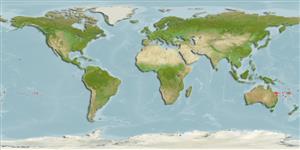
marin récifal; profondeur 0 - 10 m (Ref. 529). Tropical; 20°S - 34°S, 148°E - 108°W
Pacific Ocean: Capricorn Group of the Great Barrier Reef, Lord Howe, Norfolk, Kermadec, Cook, Austral and Easter islands; also from the Pitcairn Group.
Longueur à la première maturité / Taille / Poids / Âge
Maturité: Lm ?, range 5 - ? cm
Max length : 15.5 cm NG mâle / non sexé; (Ref. 89467)
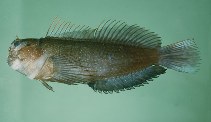
Épines dorsales (Total) : 12; Rayons mous dorsaux (Total) : 15 - 17; Épines anales: 2; Rayons mous anaux: 16 - 18; Vertèbres: 31 - 32. Diagnosis: Dorsal fin XII, 15-17 (usually 16), deeply incised above the last spine; anal fin II, 16-18 (usually 17); pectoral rays 14-16 (in general for the genus); pelvic fin I, 4; caudal fin procurrent rays 10-14. Gill rakers 25-31. Vertebrae 10 + 21-23 (usually 22); last pleural rib on 12th, last epipleural rib on 18th-23rd vertebral centrum. Body scaleless. Lateral line, anterior portion with small scalelike flaps, LL tubes 11-17 (rarely 9-10), series ends below and posterior to dorsal fin ray 12. Narrow inner ring of iris yellow, remainder black. Lower lip crenulated mesially, plicate laterally. Upper lip crenulae 34-52. Cirri, nuchal 28-42, supraorbital 4-18, nasal 8-27. Nuchal cirri in 2 groups, not overlapping at midpoint of nape, no nuchal flaps. First and second dorsal fin spine almost same height. Species name (albus - white; apicalis - apex) refers to pale tips of dorsal-fin spines. Adult brown in body color with spots; brown pupil-sized spot behind each eye. Ophioblennius stage overall light brown; lower lip both corners with dark spot; cirri brown; fins pale (in alcohol); dentary with 2-4 canines posteriorly (Ref. 529).
Body shape (shape guide): elongated; Cross section: oval.
Facultative air-breathing in the genus (Ref. 126274); Found in coral reefs and rocky reefs (Ref. 529). Oviparous. Eggs are demersal and adhesive (Ref. 205), and are attached to the substrate via a filamentous, adhesive pad or pedestal (Ref. 94114). Larvae are planktonic, often found in shallow, coastal waters (Ref. 94114).
Cycle de vie et comportement reproducteur
Maturité | Reproduction | Frai | Œufs | Fécondité | Larves
Oviparous, distinct pairing (Ref. 205). Urogenital orifice of male genital papilla located at distal tip or on posterior side of a single slender filament on a fleshy swelling behind anus; elongated testes, length equal to 2-3 times the width (Ref. 529).
Williams, J.T., 1988. Revision and phylogenetic relationships of the blenniid fish genus Cirripectes. Indo-Pac. Fish. (17):78 p. (Ref. 529)
Statut dans la liste rouge de l'IUCN (Ref. 130435: Version 2025-2 (Global))
Menace pour l'homme
Harmless
Utilisations par l'homme
Pêcheries: sans intérêt; Aquarium: Commercial
Outils
Articles particuliers
Télécharger en XML
Sources Internet
Estimations basées sur des modèles
Température préférée (Réf.
123201): 21.4 - 25.7, mean 24.8 °C (based on 183 cells).
Indice de diversité phylogénétique (Réf.
82804): PD
50 = 0.5000 [Uniqueness, from 0.5 = low to 2.0 = high].
Bayesian length-weight: a=0.00776 (0.00354 - 0.01702), b=3.00 (2.81 - 3.19), in cm total length, based on LWR estimates for this (Sub)family-body shape (Ref.
93245).
Niveau trophique (Réf.
69278): 2.0 ±0.00 se; based on food items.
Résilience (Réf.
120179): Haut, temps minimum de doublement de population inférieur à 15 mois (Preliminary K or Fecundity.).
Vulnérabilité de la pêche (Ref.
59153): Low vulnerability (10 of 100).
🛈
Nutriments (Ref.
124155): Calcium = 126 [64, 217] mg/100g; Iron = 0.8 [0.5, 1.4] mg/100g; Protein = 18 [17, 19] %; Omega3 = 0.0743 [, ] g/100g; Selenium = 24.7 [12.1, 55.5] μg/100g; VitaminA = 84.2 [20.8, 334.9] μg/100g; Zinc = 2.31 [1.53, 3.34] mg/100g (wet weight);