>
Blenniiformes (Blennies) >
Blenniidae (Combtooth blennies) > Salariinae
Etymology: Cirripectes: Latin, cirrus = curl fringe + Greek, pektos, -e, -on = made of several parts solidly united (Ref. 45335); chelomatus: Specific epithet, derived from the Greek 'cheloma' meaning notch, referring to the shallow notch in the dorsal-fin membrane above the last dorsal spine.Date follows Eschmeyer (Ref. 26282).
Umwelt: Milieu / Klimazone / Tiefenbereich / Verbreitungsgebiet
Ökologie
seewasser riff-verbunden; tiefenbereich 0 - 16 m (Ref. 529), usually 7 - 10 m (Ref. 90102). Tropical; 10°S - 33°S
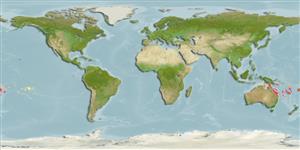
Western Pacific: off eastern Australia from Lady Musgrave Reef northward to Sir Charles Hardy Islands, as far north as Basilaki Islands, Papua New Guinea; as far south as Lord Howe Island; and eastward to Fiji and Tonga Islands.
Länge bei der ersten Reifung / Größe / Gewicht / Alter
Geschlechtsreife: Lm ?, range 4 - ? cm
Max length : 9.4 cm SL Männchen/unbestimmt; (Ref. 529)
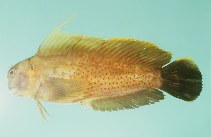
Rückenflossenstacheln (insgesamt) : 12 - 13; Rückenflossenweichstrahlen (insgesamt) : 14 - 16; Afterflossenstacheln: 2; Afterflossenweichstrahlen: 15 - 17; Wirbelzahl: 29 - 30. Diagnosis: Dorsal fin XII-XIII, 14-16 (usually XII, 15), attached to caudal fin, with shallow notch above last spine, first spine equal or about twice higher than second, higher in males; anal fin II, 15-17 (usually 15); pectoral rays 15; pelvic fin I, 4; caudal fin procurrent rays 10-14. Vertebrae 9-11 (usually 10) + 19-20; last pleural rib on 11th vertebral centrum, last epipleural rib on 15-18th. Body depth at anal-fin origin 3.3-3.5 in SL. LL, without scales and scalelike flaps; LL tubes 0-8 (usually 1-5), incomplete, series ends below 12th dorsal spine to 10th dorsal ray. Lower lip smooth mesially, plicate laterally. Upper lip crenulae 29-43. Gill rakers 20-28. Cephalic sensory pore system simple. Cirri: supraorbital 3-12 (rarely up to 23 or 93; usually 6-9); nasal 6-25 (rarely up to 82; usually less than 15); nuchal 22-45 (usually 27-32), in 4 groups with slightly expanded nuchal flap at bases of ventralmost cirri. Over all brown with red small spots; iris red; pectoral fins yellow; rugosities of anal spine dirty yellow (Ref. 529, 90102).
Body shape (shape guide): elongated; Cross section: oval.
Facultative air-breathing in the genus (Ref. 126274); Adults inhabit shallow rocky and coral reefs (Ref. 9710) commonly below 10 m (Ref. 90102). Oviparous. Eggs are demersal and adhesive (Ref. 205), and are attached to the substrate via a filamentous, adhesive pad or pedestal (Ref. 94114). Larvae are planktonic, often found in shallow, coastal waters (Ref. 94114). Common depth minimum of 7 m reported from Ref. 9710 but that is maximum common depth in Ref. 529.
Oviparous, distinct pairing (Ref. 205). Urogenital orifice of male genital papilla located basally between 2 closely appressed slender filaments on a fleshy swelling behind anus; testes bulbous with length equal to its width (Ref. 529).
Williams, J.T., 1988. Revision and phylogenetic relationships of the blenniid fish genus Cirripectes. Indo-Pac. Fish. (17):78 p. (Ref. 529)
IUCN Rote Liste Status (Ref. 130435: Version 2025-2 (Global))
Bedrohung für Menschen
Harmless
Nutzung durch Menschen
Fischereien: nicht kommerziell; Aquarium: Kommerziell
Tools
Zusatzinformationen
Download XML
Internet Quellen
Schätzungen auf der Grundlage von Modellen
Bevorzugte Temperatur (Ref.
123201): 24.6 - 28.4, mean 26.6 °C (based on 403 cells).
Phylogenetischer Diversitätsindex (Ref.
82804): PD
50 = 0.5000 [Uniqueness, from 0.5 = low to 2.0 = high].
Bayesian length-weight: a=0.00977 (0.00522 - 0.01830), b=3.03 (2.86 - 3.20), in cm total length, based on LWR estimates for this species & (Sub)family-body (Ref.
93245).
Trophische Ebene (Ref.
69278): 2.0 ±0.00 se; based on food items.
Widerstandsfähigkeit (Ref.
120179): hoch, Verdopplung der Population dauert weniger als 15 Monate. (Preliminary K or Fecundity.).
Anfälligkeit der Fischerei (Ref.
59153): Low vulnerability (10 of 100).
🛈
Nährstoffe (Ref.
124155): Calcium = 157 [76, 271] mg/100g; Iron = 0.833 [0.471, 1.487] mg/100g; Protein = 17.8 [16.6, 19.0] %; Omega3 = 0.0837 [, ] g/100g; Selenium = 23.1 [10.7, 53.1] μg/100g; VitaminA = 123 [30, 515] μg/100g; Zinc = 2.64 [1.71, 3.88] mg/100g (wet weight);