>
Blenniiformes (Blennies) >
Blenniidae (Combtooth blennies) > Salariinae
Etymology: Cirripectes: Latin, cirrus = curl fringe + Greek, pektos, -e, -on = made of several parts solidly united (Ref. 45335); hutchinsi: Named for Barry Hutchins of the Western Australian Museum.
Eponymy: Dr J Barry Hutchins (d: 1946) was Curator of Fishes at the Western Australian Museum (1998–2007), which he joined as a Technical Officer (1972) and where he worked until he retired. [...] (Ref. 128868), visit book page.
Ambiente: milieu / zona climática / intervalo de profundidade / gama de distribuição
Ecologia
marinhas associadas(os) a recifes; intervalo de profundidade 1 - 22 m (Ref. 529). Subtropical; 20°S - 33°S
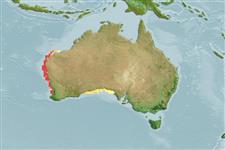
Eastern Indian Ocean: known only from Western Australia (North West Cape southward to Rottnest Island).
Comprimento na primeira maturidade / Tamanho / Peso / Idade
Maturidade: Lm ?, range 7 - ? cm
Max length : 10.6 cm SL macho/indeterminado; (Ref. 529)
Espinhos dorsais (total) : 12 - 13; Raios dorsais moles (total) : 13 - 14; Espinhos anais: 2; Raios anais moles: 15 - 16; Vértebras: 30 - 31. Diagnosis: Dorsal fin XII, 14, membrane attached to caudal fin, with deep notch above last spine, first spine almost same or slightly higher than second; anal fin II, 15; pectoral rays 15; pelvic fin I, 4; caudal fin procurrent rays 11-14. Vertebrae 10 + 20-21. LL, without scales and scalelike flaps; LL tubes 3-9 (usually 8-13), canal ends below posterior to 13h dorsal ray, usually on caudal-fin base. Upper lip crenulae 36-42. Gill rakers 23-29. Cephalic sensory pore system complex. Cirri, nuchal 35-42, nasal 8-93, supraorbital 12-29; 4 groups of nuchal cirri, each ventralmost group borne on slightly expanded nuchal flap. No pores at extra interorbital pore position. Geographic variation in color pattern exists in females; 2 color patterns in male may exist in the same geographic area; background color brown; yellow to orange iris (Ref. 529).
Body shape (shape guide): fusiform / normal; Cross section: oval.
Facultative air-breathing in the genus (Ref. 126274); Found in the surge zone in limestone holes just below the intertidal range. Common in areas where Pocillopora damicornis is present on the reefs (Ref. 529). Oviparous. Eggs are demersal and adhesive (Ref. 205), and are attached to the substrate via a filamentous, adhesive pad or pedestal (Ref. 94114). Larvae are planktonic, often found in shallow, coastal waters (Ref. 94114).
Ciclo de vida e comportamento de acasalamento
Maturidade | Reprodução | Desova | Ovos | Fecundidade | Larvas
Oviparous, distinct pairing (Ref. 205). Urogenital orifice of male genital papilla located basally between 2 widely separated slender filaments on a fleshy swelling behind anus; testes bulbous with length equal to its width (Ref. 529).
Williams, J.T., 1988. Revision and phylogenetic relationships of the blenniid fish genus Cirripectes. Indo-Pac. Fish. (17):78 p. (Ref. 529)
Categoria na Lista Vermelha da IUCN (Ref. 130435: Version 2025-2 (Global))
Ameaça para o homem
Harmless
Utilização humana
Pescarias: sem interesse
Ferramentas
Relatórios especiais
Descarregue XML
Fontes da internet
Estimativas baseadas em modelos
Temperatura preferida (Ref.
123201): 18.1 - 26.7, mean 22.2 °C (based on 115 cells).
Índice de diversidade filogenética (Ref.
82804): PD
50 = 0.5000 [Uniqueness, from 0.5 = low to 2.0 = high].
Bayesian length-weight: a=0.01047 (0.00463 - 0.02370), b=2.98 (2.79 - 3.17), in cm total length, based on LWR estimates for this (Sub)family-body shape (Ref.
93245).
Nível Trófico (Ref.
69278): 2.0 ±0.00 se; based on food items.
Resiliência (Ref.
120179): Elevada, tempo mínimo de duplicação da população menor que 15 meses (Preliminary K or Fecundity.).
Vulnerabilidade da pesca (Ref.
59153): Low vulnerability (10 of 100).
🛈
Nutrientes (Ref.
124155): Calcium = 79.9 [29.7, 158.9] mg/100g; Iron = 0.851 [0.471, 1.527] mg/100g; Protein = 19 [18, 20] %; Omega3 = 0.202 [0.108, 0.368] g/100g; Selenium = 10.3 [4.7, 23.1] μg/100g; VitaminA = 75.6 [20.1, 285.3] μg/100g; Zinc = 1.67 [1.04, 2.65] mg/100g (wet weight);