>
Blenniiformes (Blennies) >
Blenniidae (Combtooth blennies) > Salariinae
Etymology: Cirripectes: Latin, cirrus = curl fringe + Greek, pektos, -e, -on = made of several parts solidly united (Ref. 45335); kuwamurai: Named for Dr. Tetsuo Kuwamura, collector of the only known specimen.
Eponymy: Dr Tetsuo Kuwamura (d: 1950) is a Japanese scientist. [...] (Ref. 128868), visit book page.
Milieu: milieu / Klimaatzone / Diepte / verspreidingsgebied
Ecologie
marien demersaal; diepte 0 - 5 m. Temperate
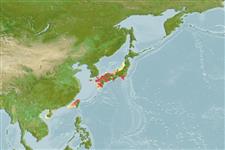
Northwest Pacific: Shirahama, Wakayama Prefecture, Japan.
Grootte / Gewicht / Leeftijd
Maturiteit: Lm ? range ? - ? cm
Max length : 5.6 cm SL mannelijk / geslacht onbekend; (Ref. 635)
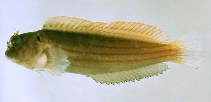
Dorsale stekels (totaal) : 12; Dorsale zachte stralen (totaal) : 16; Anale stekels: 2; Anale zachte stralen: 17; Wervels: 32. Diagnosis: Dorsal fin XII, 16, membrane attached to caudal fin, with deep notch above last spine, first spine almost same or slightly higher than second; anal fin II, 17; pectoral rays 15; pelvic fin I, 4; caudal fin rays 13, procurrent rays 10, branched 9. Vertebrae 10 + 22. LL, without scales and scalelike flaps; LL tubes 2-11 (usually 5-9), canal ends below posterior to 7th dorsal ray. Upper lip crenulae 41. Gill rakers 23. Cephalic sensory pore complex. Cirri, nuchal 30, supraorbital 13, nasal 10; ventralmost nuchal cirri borne on greatly enlarged nuchal flap; cirri above flaps have no membranous ridge connection at their bases. Overall brown, head with scarlet reticulations, body with 5 scarlet stripes; dorsal fin with red spots and distal margin (Ref. 529, 635).
Body shape (shape guide): fusiform / normal; Cross section: oval.
Facultative air-breathing in the genus (Ref. 126274); Found in a moderately exposed rocky reef about 3 m deep (Ref. 635). Oviparous. Eggs are demersal and adhesive (Ref. 205), and are attached to the substrate via a filamentous, adhesive pad or pedestal (Ref. 94114). Larvae are planktonic, often found in shallow, coastal waters (Ref. 94114).
Levenscyclus en paargedrag
Maturiteit | Voortplanting | Paaien | Eieren | Fecunditeit | Larven
Oviparous, distinct pairing (Ref. 205).
Williams, J.T., 1988. Revision and phylogenetic relationships of the blenniid fish genus Cirripectes. Indo-Pac. Fish. (17):78 p. (Ref. 529)
Status op de Rode Lijst van het IUCN (Ref. 130435: Version 2025-2 (Global))
Gevaar voor de mens
Harmless
Gebruik door de mens
Visserij: van geen belang
Tools
Speciale rapporten
Download XML
Internetbronnen
Schattingen op basis van modellen
Fylogenetische diversiteitsindex (Ref.
82804): PD
50 = 0.5000 [Uniqueness, from 0.5 = low to 2.0 = high].
Bayesian length-weight: a=0.01047 (0.00463 - 0.02370), b=2.98 (2.79 - 3.17), in cm total length, based on LWR estimates for this (Sub)family-body shape (Ref.
93245).
Trofisch niveau (Ref.
69278): 2.0 ±0.00 se; based on food items.
Weerstandsvermogen (Ref.
120179): Hoog, minimale populatieverdubbelingstijd minder dan 15 maanden (Preliminary K or Fecundity.).
Kwetsbaarheid van de visserij (Ref.
59153): Low vulnerability (10 of 100).
🛈