>
Blenniiformes (Blennies) >
Blenniidae (Combtooth blennies) > Salariinae
Etymology: Cirripectes: Latin, cirrus = curl fringe + Greek, pektos, -e, -on = made of several parts solidly united (Ref. 45335); polyzona: Specific epithet 'polys' Greek word meaning many and Latin 'zona' meaning belt, referring to the barred color pattern of adults.
More on author: Bleeker.
Milieu: milieu / Klimaatzone / Diepte / verspreidingsgebied
Ecologie
marien rifbewoner; diepte 0 - 20 m (Ref. 529), usually ? - 10 m (Ref. 90102). Tropical; 35°N - 30°S
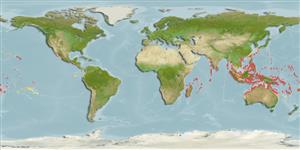
Indo-Pacific: South Africa to Kiribati, north to Japan (Ref. 559), south to Rowley Shoals and the southern Great Barrier Reef.
Lengte bij maturiteit / Grootte / Gewicht / Leeftijd
Maturiteit: Lm ?, range 4 - ? cm
Max length : 13.0 cm TL mannelijk / geslacht onbekend; (Ref. 9710)
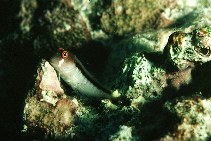
Dorsale stekels (totaal) : 11 - 13; Dorsale zachte stralen (totaal) : 13 - 15; Anale stekels: 2; Anale zachte stralen: 14 - 16; Wervels: 29 - 31. Diagnosis: Dorsal fin XI-XIII (usually XII), 13-15, deeply incised above last spine, first spine almost equal to second; anal fin II, 14-16 (usually 15); pectoral rays 15; pelvic fin I, 3; caudal fin procurrent rays 9-12. Vertebrae 10 + 19-20; last pleural rib on 11th, last epipleural rib on 15-19th vertebral centrum. Without scales and scalelike flaps. LL tubes 2-9 (usually 4-7), series ends below dorsal fin ray 7 or after. Lower lip smooth mesially, plicate laterally. Upper lip crenulae 32-45. Gill rakers 18-25. Cephalic sensory pore system complex; 1 pore behind nuchal flap. Cirri supraorbital 4-15, nasal 5-24; nuchal 32-44. Nuchal cirri in 4 groups with slightly expanded nuchal flap. Head reticulated with pale grey spots. Iris inner ring yellow, outer ring red. Body dark brown with 12 pale grey bars. Juvenile tan above, white to lavender below, with broad dark midlateral stripe, white eye bar, yellow spots on head underside and on operculum. No geographical variation recorded but secondary sexual dichromatism was found (Ref. 529, 90102). Three color pattern variation noted in Ref. 635.
Body shape (shape guide): elongated; Cross section: oval.
Facultative air-breathing in the genus (Ref. 126274); Occur in algal ridge and ridge crests between surge channels of exposed seaward reefs to a depth of about 3 m (Ref. 205, 58302). Benthic (Ref. 58302). Feed on algae and associated minute invertebrates like forams, ostracods, and gastropods. Oviparous. Eggs are demersal and adhesive (Ref. 205), and are attached to the substrate via a filamentous, adhesive pad or pedestal (Ref. 94114). Larvae are planktonic, often found in shallow, coastal waters (Ref. 94114).
Oviparous, distinct pairing (Ref. 205). Urogenital orifice of male genital papilla located basally between 2 widely separated slender filaments on a fleshy swelling behind anus; testes bulbous with length equal its width (Ref. 529).
Williams, J.T., 1988. Revision and phylogenetic relationships of the blenniid fish genus Cirripectes. Indo-Pac. Fish. (17):78 p. (Ref. 529)
Status op de Rode Lijst van het IUCN (Ref. 130435: Version 2025-2 (Global))
Gevaar voor de mens
Harmless
Gebruik door de mens
Visserij: van geen belang
Tools
Speciale rapporten
Download XML
Internetbronnen
Schattingen op basis van modellen
Gewenste temperatuur (Ref.
123201): 26.1 - 29.3, mean 28.5 °C (based on 2768 cells).
Fylogenetische diversiteitsindex (Ref.
82804): PD
50 = 0.5000 [Uniqueness, from 0.5 = low to 2.0 = high].
Bayesian length-weight: a=0.00776 (0.00354 - 0.01702), b=3.00 (2.81 - 3.19), in cm total length, based on LWR estimates for this (Sub)family-body shape (Ref.
93245).
Trofisch niveau (Ref.
69278): 2.8 ±0.38 se; based on food items.
Weerstandsvermogen (Ref.
120179): Hoog, minimale populatieverdubbelingstijd minder dan 15 maanden (Preliminary K or Fecundity.).
Kwetsbaarheid van de visserij (Ref.
59153): Low vulnerability (10 of 100).
🛈
Voedingsstoffen (Ref.
124155): Calcium = 124 [63, 189] mg/100g; Iron = 0.732 [0.442, 1.198] mg/100g; Protein = 18.2 [17.1, 19.3] %; Omega3 = 0.0901 [, ] g/100g; Selenium = 24.4 [12.6, 50.0] μg/100g; VitaminA = 118 [37, 377] μg/100g; Zinc = 1.99 [1.36, 2.76] mg/100g (wet weight);