>
Blenniiformes (Blennies) >
Blenniidae (Combtooth blennies) > Salariinae
Etymology: Cirripectes: Latin, cirrus = curl fringe + Greek, pektos, -e, -on = made of several parts solidly united (Ref. 45335); quagga: Specific epithet 'quagga' is of Hottentot origin and refers to the extinct species of Equus, related to zebra. Name refers to the rather obscure cross lines or bands.
More on authors: Fowler & Ball.
Environnement : milieu / zone climatique / profondeur / gamme de distribution
Écologie
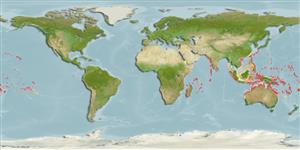
marin récifal; profondeur 0 - 19 m (Ref. 529), usually 0 - 10 m (Ref. 529). Tropical; 30°N - 35°S, 21°E - 129°W
Indo-Pacific: South Africa to Tanzania, east to Henderson Island, Pitcairn and the Hawaiian Islands; north to China; south to the Great Barrier Reef.
Longueur à la première maturité / Taille / Poids / Âge
Maturité: Lm ?, range 3 - ? cm
Max length : 10.0 cm TL mâle / non sexé; (Ref. 9710)
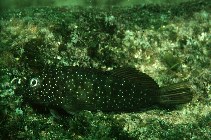
Épines dorsales (Total) : 11 - 13; Rayons mous dorsaux (Total) : 14 - 16; Épines anales: 2; Rayons mous anaux: 15 - 17; Vertèbres: 30 - 32. Diagnosis: Dorsal fin XII, 15, membrane attached to caudal fin, with deep notch above last spine, first spine about equal to twice higher than second; anal fin II, 16; pectoral rays 15; pelvic fin I, 4; caudal fin procurrent rays 10-15. Vertebrae 10 + 21. LL, without scales and scalelike flaps; LL tubes 7-18 (usually 10-18), canal ends below 7th dorsal ray to caudal-fin base. Lower lip crenulated mesially, plicate laterally. Upper lip crenulae 32-46. Gill rakers 18-26. Cephalic sensory pore system complex. Midsnout pores present. Cirri, supraorbital 2-15, nasal 6-16; nuchal 23-36, in 2 groups separated at midpoint of nape, no nuchal flap. Body depth at anal-fin origin 4.3 in SL. Head and body deep and greatly compressed; snout broad and obtuse, convex in profile; eye high and advanced; mouth broad and lower jaw inferior slightly. Geographic variation in color pattern exists; variable body pigmentation - some uniformly brown, other forms with bars or spots, or have colored peduncles, usually yellow or scarlet; black iris with yellow, irregular-shaped inner ring. (Ref. 529, 634, 90102)
Body shape (shape guide): elongated; Cross section: compressed.
Facultative air-breathing in the genus (Ref. 126274); Found in algal ridge and crests between surge channels of exposed seaward reefs (Ref. 205, 58302). Usually taken in water less than 10 m deep, but has been collected at depths as great as 19 m (Ref. 529). Feeds on benthic algae (Ref. 89972). Benthic (Ref. 58302). Oviparous. Eggs are demersal and adhesive (Ref. 205), and are attached to the substrate via a filamentous, adhesive pad or pedestal (Ref. 94114). Larvae are planktonic, often found in shallow, coastal waters (Ref. 94114).
Cycle de vie et comportement reproducteur
Maturité | Reproduction | Frai | Œufs | Fécondité | Larves
Oviparous, distinct pairing (Ref. 205). Urogenital orifice of male genital papilla located behind a single slender filament on a fleshy swelling behind anus; elongated testes with width equals about about half its length (Ref. 529).
Williams, J.T., 1988. Revision and phylogenetic relationships of the blenniid fish genus Cirripectes. Indo-Pac. Fish. (17):78 p. (Ref. 529)
Statut dans la liste rouge de l'IUCN (Ref. 130435: Version 2025-2 (Global))
Menace pour l'homme
Harmless
Utilisations par l'homme
Outils
Articles particuliers
Télécharger en XML
Sources Internet
Estimations basées sur des modèles
Température préférée (Réf.
123201): 24.9 - 29.3, mean 28.2 °C (based on 2463 cells).
Indice de diversité phylogénétique (Réf.
82804): PD
50 = 0.5000 [Uniqueness, from 0.5 = low to 2.0 = high].
Bayesian length-weight: a=0.00776 (0.00354 - 0.01702), b=3.00 (2.81 - 3.19), in cm total length, based on LWR estimates for this (Sub)family-body shape (Ref.
93245).
Niveau trophique (Réf.
69278): 2.0 ±0.00 se; based on food items.
Résilience (Réf.
120179): Haut, temps minimum de doublement de population inférieur à 15 mois (Preliminary K or Fecundity.).
Vulnérabilité de la pêche (Ref.
59153): Low vulnerability (10 of 100).
🛈
Nutriments (Ref.
124155): Calcium = 154 [76, 265] mg/100g; Iron = 0.854 [0.486, 1.505] mg/100g; Protein = 17.8 [16.6, 19.0] %; Omega3 = 0.084 [0.045, 0.152] g/100g; Selenium = 25.3 [11.8, 57.9] μg/100g; VitaminA = 109 [27, 453] μg/100g; Zinc = 2.61 [1.70, 3.81] mg/100g (wet weight);