>
Blenniiformes (Blennies) >
Blenniidae (Combtooth blennies) > Salariinae
Etymology: Cirripectes: Latin, cirrus = curl fringe + Greek, pektos, -e, -on = made of several parts solidly united (Ref. 45335); vanderbilti: Named for M. George Vanderbilt.
Eponymy: George Washington Vanderbilt III (1914–1961) was a scientific explorer whose main interest was marine life. [...] (Ref. 128868), visit book page.
More on author: Fowler.
Taxonomic Remarks
close to C. variolosus
Milieu: milieu / Klimaatzone / Diepte / verspreidingsgebied
Ecologie
marien rifbewoner; diepte 1 - 10 m (Ref. 529). Tropical; 25°N - 15°N
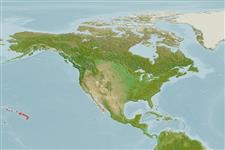
Eastern Central Pacific: Hawaiian and Johnston islands. Has been confused with the closely related species Cirripectes variolosus (Ref. 583).
Lengte bij maturiteit / Grootte / Gewicht / Leeftijd
Maturiteit: Lm ?, range 4 - ? cm
Max length : 10.0 cm SL mannelijk / geslacht onbekend; (Ref. 529)
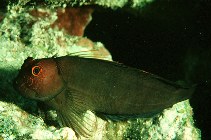
Dorsale stekels (totaal) : 12; Dorsale zachte stralen (totaal) : 13 - 15; Anale stekels: 2; Anale zachte stralen: 15 - 16; Wervels: 30 - 31. Diagnosis: Dorsal fin XII, 14, membrane attached to caudal fin, with deep notch above last spine, first spine slightly higher than second; anal fin II, 15; pectoral rays 15; pelvic fin I, 4; caudal fin procurrent rays 10-12. Vertebrae 10 + 20. LL, without scales but with scalelike flaps; LL tubes 0-5, canal ends below 7th dorsal ray and caudal-fin base. Lower lip smooth mesially, plicate laterally. Upper lip crenulae 42-54. Gill rakers 23-30. Cephalic pore system complex; midsnout pores present. Cirri, supraorbital 9-22, nasal 7-23; nuchal 31-42, in 2 groups with ventralmost cirri borne on small nuchal flap. Adults with brown body; red spots or narrow lines on snout and around the eye; black iris with yellow-ringed pupil and an outer bright reddish orange ring (Ref. 529).
Body shape (shape guide): fusiform / normal; Cross section: oval.
Facultative air-breathing in the genus (Ref. 126274); Benthic in coral and rock (Ref. 58302). The most common blenny on shallow reefs. Adults feed on benthic algae and detritus (Ref. 3921). Oviparous. Eggs are demersal and adhesive (Ref. 205), and are attached to the substrate via a filamentous, adhesive pad or pedestal (Ref. 94114). Larvae are planktonic, often found in shallow, coastal waters (Ref. 94114).
Oviparous, distinct pairing (Ref. 205). Urogenital orifice of male genital papilla located basally between 2 closely appressed slender filaments on a fleshy swelling behind anus; testes bulbous with length equal its width (Ref. 529).
Williams, J.T., 1988. Revision and phylogenetic relationships of the blenniid fish genus Cirripectes. Indo-Pac. Fish. (17):78 p. (Ref. 529)
Status op de Rode Lijst van het IUCN (Ref. 130435: Version 2025-2 (Global))
Gevaar voor de mens
Harmless
Gebruik door de mens
Visserij: van geen belang; Aquarium: Commercieel
Tools
Speciale rapporten
Download XML
Internetbronnen
Schattingen op basis van modellen
Gewenste temperatuur (Ref.
123201): 24.8 - 25.6, mean 25.3 °C (based on 29 cells).
Fylogenetische diversiteitsindex (Ref.
82804): PD
50 = 0.5000 [Uniqueness, from 0.5 = low to 2.0 = high].
Bayesian length-weight: a=0.01047 (0.00463 - 0.02370), b=2.98 (2.79 - 3.17), in cm total length, based on LWR estimates for this (Sub)family-body shape (Ref.
93245).
Trofisch niveau (Ref.
69278): 2.0 ±0.00 se; based on food items.
Weerstandsvermogen (Ref.
120179): Hoog, minimale populatieverdubbelingstijd minder dan 15 maanden (Preliminary K or Fecundity.).
Kwetsbaarheid van de visserij (Ref.
59153): Low vulnerability (10 of 100).
🛈
Voedingsstoffen (Ref.
124155): Calcium = 136 [71, 236] mg/100g; Iron = 0.887 [0.519, 1.470] mg/100g; Protein = 18.4 [17.2, 19.4] %; Omega3 = 0.124 [0.073, 0.210] g/100g; Selenium = 19 [10, 37] μg/100g; VitaminA = 128 [36, 453] μg/100g; Zinc = 2.56 [1.72, 3.69] mg/100g (wet weight);