>
Blenniiformes (Blennies) >
Blenniidae (Combtooth blennies) > Salariinae
Etymology: Cirripectes: Latin, cirrus = curl fringe + Greek, pektos, -e, -on = made of several parts solidly united (Ref. 45335).
More on author: Valenciennes.
Entorno: milieu / zona climática / rango de profundidad / gama de distribución
Ecología
marino asociado a arrecife; rango de profundidad 0 - 31 m (Ref. 529), usually 1 - 5 m (Ref. 58302). Tropical; 28°N - 28°S
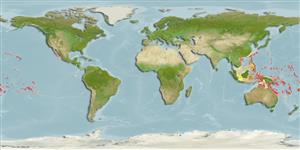
Pacific Ocean: Palau to Johnston Islands, Marquesas and Pitcairn Islands, north to the Bonin Islands, south to Rapa; throughout Micronesia.
Longitud en la primera madurez / Tamaño / Peso / Edad
Madurez: Lm ?, range 6 - ? cm
Max length : 8.9 cm SL macho / no sexado; (Ref. 529)
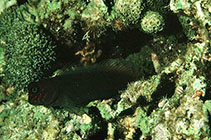
Espinas dorsales (total) : 11 - 13; Radios blandos dorsales (total) : 13 - 15; Espinas anales: 2; Radios blandos anales: 14 - 16; Vértebra: 29 - 31. Dorsal fin XII, 14, membrane attached to caudal fin, with deep notch above last spine, first spine slightly higher than second; anal fin II, 15; pectoral rays 15; pelvic fin I, 4; caudal fin procurrent rays 10-14. Vertebrae 10 + 20. LL, without scales but with scalelike flaps; LL tubes 1-11, canal ends below 7th dorsal ray and caudal-fin base. Lower lip smooth mesially, plicate laterally. Upper lip crenulae 37-51. Gill rakers 23-29. Cephalic pore system complex; midsnout pores present. Cirri, supraorbital 4-14, nasal 4-19; nuchal 27-38, in 4 groups, bases of ventralmost groups slightly expanded. Adults with brown body; red spots or narrow lines on snout and around the eye; iris silvery (Ref. 529). Anterior nare is tubular and provided with an apical lid that prevents the penetration of sand particles (Ref. 94108).
Body shape (shape guide): fusiform / normal; Cross section: oval.
Facultative air-breathing in the genus (Ref. 126274); Adults inhabit exposed seaward reefs where it usually shelters at bases or among the branches of Pocilloporid corals (Ref. 1602). Feeds on benhic algae (Ref. 89972). Benthic (Ref. 58302). Oviparous. Eggs are demersal and adhesive (Ref. 205), and are attached to the substrate via a filamentous, adhesive pad or pedestal (Ref. 94114). Larvae are planktonic, often found in shallow, coastal waters (Ref. 94114).
Ciclo vital y comportamiento de apareamiento
Madurez | Reproducción | Puesta | Huevos | Fecundidad | Larva
Oviparous, distinct pairing (Ref. 205). Urogenital orifice of male genital papilla located basally between 2 widely separated slender filaments on a fleshy swelling behind anus; testes bulbous with length equal its width (Ref. 529).
Williams, J.T., 1988. Revision and phylogenetic relationships of the blenniid fish genus Cirripectes. Indo-Pac. Fish. (17):78 p. (Ref. 529)
Situación en la Lista Roja de la UICN (Ref. 130435: Version 2025-2 (Global))
Amenaza para el ser humano
Harmless
Usos humanos
Pesquerías: sin interés; Acuario: Comercial
Herramientas
Informes especiales
Descargar XML
Fuentes de Internet
Estimaciones basadas en modelos
Temperatura preferida (Referencia
123201): 24.9 - 29.3, mean 28.2 °C (based on 1525 cells).
Índice de diversidad filogenética (Referencia
82804): PD
50 = 0.5000 [Uniqueness, from 0.5 = low to 2.0 = high].
Bayesian length-weight: a=0.01047 (0.00463 - 0.02370), b=2.98 (2.79 - 3.17), in cm total length, based on LWR estimates for this (Sub)family-body shape (Ref.
93245).
Nivel trófico (Referencia
69278): 2.0 ±0.00 se; based on food items.
Resiliencia (Referencia
120179): Alto, población duplicada en un tiempo mínimo inferior a 15 meses (Preliminary K or Fecundity.).
Vulnerabilidad pesquera (Ref.
59153): Low vulnerability (10 of 100).
🛈
Nutrientes (Ref.
124155): Calcium = 138 [72, 238] mg/100g; Iron = 0.908 [0.544, 1.483] mg/100g; Protein = 18.3 [17.1, 19.3] %; Omega3 = 0.142 [0.085, 0.234] g/100g; Selenium = 23.5 [12.9, 45.9] μg/100g; VitaminA = 127 [36, 437] μg/100g; Zinc = 2.58 [1.75, 3.68] mg/100g (wet weight);