>
Eupercaria/misc (Various families in series Eupercaria) >
Sparidae (Porgies)
Etymology: Argyrops: Greek, argyros = silver, silvered + Gree, ops = appearance (Ref. 45335).
More on author: Forsskål.
Umwelt: Milieu / Klimazone / Tiefenbereich / Verbreitungsgebiet
Ökologie
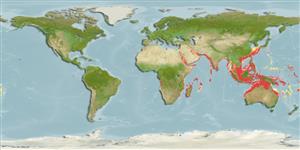
seewasser demersal; tiefenbereich 1 - 450 m (Ref. 100719), usually 5 - 100 m (Ref. 30573). Tropical; 34°N - 28°S
Indian Ocean: including the Red Sea and Persian Gulf, to Singapore and southernmost end of the Malay Peninsula.
Länge bei der ersten Reifung / Größe / Gewicht / Alter
Geschlechtsreife: Lm 30.9 range ? - ? cm
Max length : 80.0 cm TL Männchen/unbestimmt; (Ref. 124569); common length : 30.0 cm TL Männchen/unbestimmt; (Ref. 3507)
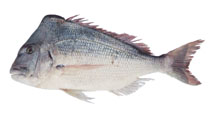
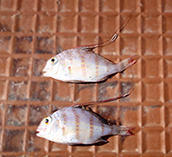
Rückenflossenstacheln (insgesamt) : 11 - 13; Rückenflossenweichstrahlen (insgesamt) : 9 - 10; Afterflossenstacheln: 3; Afterflossenweichstrahlen: 7 - 8; Wirbelzahl: 24. This species is distinguished from all its congeners by the following set of characters: body deep and becoming compressed and less deep with growth; D XII,10, the first 2 dorsal-fin spines rudimentary (2 dorsal-fin spines on first dorsal pterygiophore); the dorsal-fin with two morpho types of configuration (Type I 'rigid type', fragile] as a rigid tapering spine and Type II ['flexible type', comparatively robust] as a flexible tapering spine in Group A - Red Sea, Group B - Gulf of Aden and eastern coast of Africa, and Group C - Persian Gulf, only Type II, is seen in both Group D - Madagascar to Sri Lanka and Group E - Eastern Indian Ocean, each Group is allopatric and is likely to have similar genetic structure (not analyzed in Group D or E). Colouration: body uniform pink with belly and lower jaw silvery, head red; spinous dorsal fin pink or red, other fins pink or pale pink; with pink tinge around eye; upper jaw often pinkish; anterior and posterior margins of the upper cheek scales nearly parallel just below rear edge of eye; orbit diameter is clearly less than suborbital depth (Ref. 124569).
Cross section: compressed.
Found in a wide range of bottoms. Young fish occur in very shallow waters of sheltered bays; larger individuals in deeper water. Feed on benthic invertebrates, mainly mollusks (Ref. 5213). Important food fish.
Iwatsuki, Y. and P.C. Heemstra, 2018. Taxonomic review of the genus Argyrops (Perciformes; Sparidae) with three new species from the Indo-West Pacific. Zootaxa 4438(3):401-442. (Ref. 124569)
IUCN Rote Liste Status (Ref. 130435: Version 2025-2 (Global))
Bedrohung für Menschen
Harmless
Nutzung durch Menschen
Fischereien: kommerziell
Tools
Zusatzinformationen
Download XML
Internet Quellen
Schätzungen auf der Grundlage von Modellen
Bevorzugte Temperatur (Ref.
123201): 23.4 - 29, mean 27.9 °C (based on 3786 cells).
Phylogenetischer Diversitätsindex (Ref.
82804): PD
50 = 0.5078 [Uniqueness, from 0.5 = low to 2.0 = high].
Bayesian length-weight: a=0.02188 (0.01857 - 0.02577), b=2.96 (2.92 - 3.00), in cm total length, based on LWR estimates for this species (Ref.
93245).
Trophische Ebene (Ref.
69278): 3.7 ±0.38 se; based on food items.
Generation time: 7.3 (4.7 - 12.2) years. Estimated as median ln(3)/K based on 10
growth studies.
Widerstandsfähigkeit (Ref.
120179): niedrig, Verdopplung der Population dauert 4,5 - 14 Jahre. (K=0.08-0.21; tmax=25; tm=2; Fec = 47,000).
Anfälligkeit der Fischerei (Ref.
59153): High vulnerability (55 of 100).
🛈
Klimaanfälligkeit (Ref.
125649): High vulnerability (61 of 100).
🛈
Nährstoffe (Ref.
124155): Calcium = 85.7 [37.7, 186.4] mg/100g; Iron = 1.02 [0.52, 2.18] mg/100g; Protein = 18.8 [17.4, 20.1] %; Omega3 = 0.234 [0.119, 0.453] g/100g; Selenium = 82.6 [34.7, 189.3] μg/100g; VitaminA = 16.6 [4.1, 69.2] μg/100g; Zinc = 0.607 [0.370, 0.930] mg/100g (wet weight);