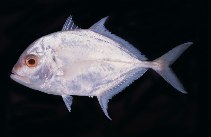
Klassifizierung / Names
Namen | Synonyme | Catalog of Fishes(Gattung, Arten) | ITIS | CoL | WoRMS | Cloffa
>
Carangiformes (Jacks) >
Carangidae (Jacks and pompanos) > Caranginae
Etymology: Platycaranx: Name derived from Greek 'platys' meaning 'fat', and Caranx for the type genus of Carangidae, referring to the highly compressed body.
More on authors: Bloch & Schneider.
Umwelt: Milieu / Klimazone / Tiefenbereich / Verbreitungsgebiet
Ökologie
seewasser riff-verbunden; amphidrom (Ref. 51243); tiefenbereich 20 - 140 m (Ref. 11441). Tropical; 40°N - 40°S, 26°E - 170°W
Indo-West Pacific: east coast of Africa (without verified records from the Red Sea) to Sri Lanka and farther eastward to the Gulf of Thailand, north to Japan and south to Australia.
Größe / Gewicht / Alter
Geschlechtsreife: Lm ? range ? - ? cm
Max length : 60.0 cm TL Männchen/unbestimmt; (Ref. 2334); common length : 30.0 cm TL Männchen/unbestimmt; (Ref. 2334)
Rückenflossenstacheln (insgesamt) : 9; Rückenflossenweichstrahlen (insgesamt) : 20 - 23; Afterflossenstacheln: 3; Afterflossenweichstrahlen: 17 - 19.
Body shape (shape guide): short and / or deep; Cross section: compressed.
Adults occur in the continental shelf, near rocks and coral reefs (Ref. 7300). They feed on crustaceans, small squids, and fishes (Ref. 5213). Juveniles are found in sandy bays (Ref. 2334). Marketed fresh, may be dried or salted (Ref. 5284).
Lebenszyklus und Paarungsverhalten
Geschlechtsreife | Fortpflanzung | Ablaichen | Eier | Fruchtbarkeit | Larven
Randall, J.E., G.R. Allen and R.C. Steene, 1990. Fishes of the Great Barrier Reef and Coral Sea. University of Hawaii Press, Honolulu, Hawaii. 506 p. (Ref. 2334)
IUCN Rote Liste Status (Ref. 130435: Version 2025-2 (Global))
Bedrohung für Menschen
Harmless
Nutzung durch Menschen
Fischereien: kommerziell; Sportfisch: ja
Tools
Zusatzinformationen
Download XML
Internet Quellen
Schätzungen auf der Grundlage von Modellen
Bevorzugte Temperatur (Ref.
123201): 22.6 - 28.4, mean 27.2 °C (based on 887 cells).
Phylogenetischer Diversitätsindex (Ref.
82804): PD
50 = 0.6250 [Uniqueness, from 0.5 = low to 2.0 = high].
Bayesian length-weight: a=0.02239 (0.01783 - 0.02811), b=2.90 (2.84 - 2.96), in cm total length, based on LWR estimates for this species (Ref.
93245).
Trophische Ebene (Ref.
69278): 3.9 ±0.54 se; based on food items.
Widerstandsfähigkeit (Ref.
120179): hoch, Verdopplung der Population dauert weniger als 15 Monate. (K=0.68-0.96;).
Prior r = 1.19, 95% CL = 0.79 - 1.79, Based on 1 data-limited stock assessment.
Anfälligkeit der Fischerei (Ref.
59153): Low to moderate vulnerability (25 of 100).
🛈
Klimaanfälligkeit (Ref.
125649): Moderate to high vulnerability (54 of 100).
🛈
Nährstoffe (Ref.
124155): Calcium = 36.4 [16.1, 83.5] mg/100g; Iron = 1.49 [0.64, 3.43] mg/100g; Protein = 19.7 [17.0, 21.9] %; Omega3 = 0.137 [0.070, 0.285] g/100g; Selenium = 14.6 [6.1, 40.3] μg/100g; VitaminA = 32.8 [5.3, 216.2] μg/100g; Zinc = 0.546 [0.280, 1.229] mg/100g (wet weight);