>
Eupercaria/misc (Various families in series Eupercaria) >
Gerreidae (Mojarras)
Etymology: Pentaprion: Greek, pente = five + Greek, prion = saw (Ref. 45335).
Environnement : milieu / zone climatique / profondeur / gamme de distribution
Écologie
marin; saumâtre démersal; profondeur 15 - 220 m (Ref. 12260). Tropical; 33°N - 28°S, 47°E - 158°E
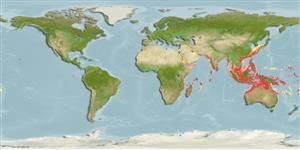
Indo-West Pacific: western and southern coasts of India and off Sri Lanka to Indonesia, the Philippines and Ryukyu Islands, and south to the northern part of Australia (Ref. 3131).
Taille / Poids / Âge
Maturité: Lm ? range ? - ? cm
Max length : 15.0 cm TL mâle / non sexé; (Ref. 2872); common length : 10.0 cm TL mâle / non sexé; (Ref. 2872)
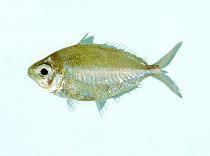
Épines dorsales (Total) : 9 - 10; Rayons mous dorsaux (Total) : 14 - 15; Épines anales: 5 - 6; Rayons mous anaux: 12 - 13. Body is slender, with weakly attached silvery scales. The spines of the dorsal and anal fins longer than the rays; the pectoral fins long and pointed, reaching beyond the anal fin spines; the anal fin is long; the caudal fin lobes rounded.
Body shape (shape guide): fusiform / normal; Cross section: compressed.
Inhabits coastal waters. Forms large schools. Probably feeds on small benthic animals. Used for fish meal and duck food.
Cycle de vie et comportement reproducteur
Maturité | Reproduction | Frai | Œufs | Fécondité | Larves
Woodland, D.J., 1984. Gerreidae. In W. Fischer and G. Bianchi (eds.) FAO species identification sheets for fishery purposes. Western Indian Ocean fishing area 51. Vol. 2. [pag. var.]. FAO, Rome. (Ref. 3409)
Statut dans la liste rouge de l'IUCN (Ref. 130435: Version 2025-2 (Global))
Menace pour l'homme
Harmless
Utilisations par l'homme
Pêcheries: intérêt commercial mineur
Outils
Articles particuliers
Télécharger en XML
Sources Internet
Estimations basées sur des modèles
Température préférée (Réf.
123201): 21.1 - 28.3, mean 26.6 °C (based on 974 cells).
Indice de diversité phylogénétique (Réf.
82804): PD
50 = 1.0000 [Uniqueness, from 0.5 = low to 2.0 = high].
Bayesian length-weight: a=0.01122 (0.00925 - 0.01362), b=3.05 (3.00 - 3.10), in cm total length, based on LWR estimates for this species (Ref.
93245).
Niveau trophique (Réf.
69278): 3.4 ±0.2 se; based on diet studies.
Generation time: 1.2 (1.0 - 1.4) years. Estimated as median ln(3)/K based on 16
growth studies.
Résilience (Réf.
120179): Haut, temps minimum de doublement de population inférieur à 15 mois (K=0.40-1.80).
Vulnérabilité de la pêche (Ref.
59153): Low to moderate vulnerability (27 of 100).
🛈
Nutriments (Ref.
124155): Calcium = 223 [91, 694] mg/100g; Iron = 0.874 [0.382, 2.690] mg/100g; Protein = 18.8 [16.5, 20.9] %; Omega3 = 0.323 [0.154, 0.725] g/100g; Selenium = 54.9 [20.4, 162.9] μg/100g; VitaminA = 11.7 [2.8, 49.6] μg/100g; Zinc = 1.11 [0.63, 2.73] mg/100g (wet weight); based on
nutrient studies.