Entorno: milieu / zona climática / rango de profundidad / gama de distribución
Ecología
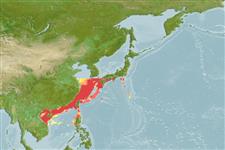
marino demersal; oceanodromo (Ref. 51243); rango de profundidad 10 - 200 m (Ref. 41299). Subtropical; 34°N - 15°N
Northwest Pacific: northeastern part of South China Sea (Philippines excluded) northward to Japan.
Longitud en la primera madurez / Tamaño / Peso / Edad
Madurez: Lm 34.3 range ? - ? cm
Max length : 100.0 cm SL macho / no sexado; (Ref. 559); common length : 30.0 cm TL macho / no sexado; (Ref. 2115); peso máximo publicado: 9.7 kg (Ref. 40637); edad máxima reportada: 26 años (Ref. 56606)
Descripción breve
Claves de identificación | Morfología | Morfometría
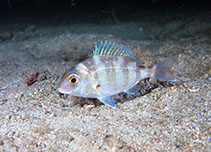
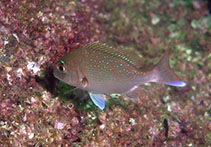
Espinas dorsales (total) : 12; Radios blandos dorsales (total) : 10; Espinas anales: 3; Radios blandos anales: 8. Body with many bluish dots when fresh. Shallow body, body depth 2 or more in SL. Transverse scales 6.5-7.5. All spines of dorsal fin tough and not elongated. Posterior margin of caudal fin black, lower margin white (Ref. 42199).
Body shape (shape guide): fusiform / normal; Cross section: oval.
Occurs from 10 to 50 m depths, often on rough grounds, but also on softer bottoms. Also inhabits reefs (Ref. 9988). Adults migrate into shallower parts of their depth range to spawn in late spring and summer; juveniles occur mainly in the shallower areas. It is a popular food fish throughout its range. It is high-priced in Japan and used in various occasions such as wedding and festival. Feeds on benthic invertebrates, including echinoderms, worms, mollusks and crustaceans; also on fishes. Marketed live, fresh and frozen; eaten steamed, pan-fried, broiled, boiled and baked (Ref. 9988). Cultivated in cages (Ref. 9988). Used in Chinese medicine (Ref. 12166).
Conflicting descriptions of the reproductive style of this species have been reported, e.g., Ref. 34228 describe this species as being a gonochorist (Ref. 28504). After clarificatory analyses on the protogynous characteristics of this species, gonochorism is confirmed (Ref. 103751).
Eggleston, D., 1974. Sparidae. In W. Fischer and P.J.P. Whitehead (eds.) FAO species identification sheets for fishery purposes. Eastern Indian Ocean (Fishing Area 57) and Western Central Pacific (Fishing Area 71), Volume 4. FAO, Rome. (Ref. 2115)
Situación en la Lista Roja de la UICN (Ref. 130435: Version 2025-2 (Global))
Amenaza para el ser humano
Harmless
Usos humanos
Pesquerías: muy comercial; Acuicultura: comercial; pesca deportiva: si; Acuario: Acuarios públicos
Herramientas
Informes especiales
Descargar XML
Fuentes de Internet
Estimaciones basadas en modelos
Temperatura preferida (Referencia
123201): 17 - 24.4, mean 21.8 °C (based on 143 cells).
Índice de diversidad filogenética (Referencia
82804): PD
50 = 0.5156 [Uniqueness, from 0.5 = low to 2.0 = high].
Bayesian length-weight: a=0.01288 (0.01143 - 0.01452), b=3.03 (3.00 - 3.06), in cm total length, based on LWR estimates for this species (Ref.
93245).
Nivel trófico (Referencia
69278): 4.5 ±0.7 se; based on diet studies.
Resiliencia (Referencia
120179): Bajo, población duplicada en un tiempo mínimo de 4.5-14 años (Preliminary K or Fecundity.).
Prior r = 0.22, 95% CL = 0.15 - 0.33, Based on 1 full stock assessment.
Vulnerabilidad pesquera (Ref.
59153): High vulnerability (58 of 100).
🛈
Nutrientes (Ref.
124155): Calcium = 48.2 [26.4, 91.9] mg/100g; Iron = 1.48 [0.51, 3.85] mg/100g; Protein = 20.6 [18.9, 22.2] %; Omega3 = 0.328 [0.152, 0.664] g/100g; Selenium = 33.6 [15.5, 66.8] μg/100g; VitaminA = 13.5 [4.1, 42.2] μg/100g; Zinc = 0.433 [0.220, 0.895] mg/100g (wet weight);