>
Acanthuriformes (Surgeonfishes) >
Leiognathidae (Slimys, slipmouths, or ponyfishes) > Leiognathinae
Etymology: Leiognathus: Greek, leios = smooth + Greek, gnathos = jaw (Ref. 45335).
More on author: Forsskål.
Lingkungan: lingkungan / zona iklim / kisaran kedalaman / jangkauan distribusi
Ekologi
laut; air tawar; payau dasar (demersal); amphidromus; kisaran kedalaman 10 - 110 m (Ref. 12260). Tropical; 26°C - 29°C (Ref. 4959); 30°N - 36°S, 27°E - 170°W
Indo-West Pacific: Red Sea, Persian Gulf and East Africa (including Reunion, Comoros, Seychelles, Madagascar and Mauritius) to Fiji, north to the Ryukyu Islands, south to Australia.
Panjang pada saat jatuh tempo pertama / Ukuran / Berat / umur
Kematangan: Lm 10.7 range ? - ? cm
Max length : 28.0 cm TL jantan/; (Ref. 9710); common length : 18.0 cm TL jantan/; (Ref. 47581)
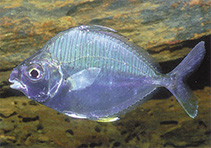
Duri punggung (Keseluruhan (total)) : 8; duri punggung lunak (Keseluruhan (total)) : 15 - 16; Duri dubur: 3; Sirip dubur lunak: 14 - 15. This species is distinguished by the following characters: body very deep, compressed, with a strongly humped back; body depth 1.7-1.9 times in standard length; mouth pointing downward when protracted; gill rakers short and fleshy, less than 1/2 length of corresponding gill lamellae, total gill rakers on first gill arch 18-22; head and breast scaleless; tubed scales on lateral line 61-66. Colour of adults, back greyish, belly silvery and many parallel close-set faint bars on back; usually a dark brown saddle on caudal peduncle; axil of pectoral fins grey to black; margin of soft dorsal fin black; both caudal-fin lobes with broad dusky margins; pectoral, pelvic, and anal fins colourless to yellowish. In juveniles (5-7 cm TL), thin, closely arranged, grey vertical lines descending from back to about midheight; membrane between anal-fin spines conspicuously yellow; posterior margin of caudal-fin lobes pale yellow and dusky; other fins hyaline; snout dotted black (Ref. 47581).
Body shape (shape guide): short and / or deep; Cross section: compressed.
Found in river mouths and muddy inshore areas (Ref. 2847, 37816), often in mangrove areas (Ref. 48635). Adults are coastal inhabitants found on soft bottoms, usually between depths of 10-70 meters. Juveniles are commonly found in mangrove estuaries and tidal creeks, sometimes entering the lower reaches of freshwater streams (Ref. 44894). Adults move in schools. Frequently ascend into freshwater reaches of rivers (Ref. 12693). Active by day (Ref. 12693). Feed on polychaetes, small crustaceans, small fishes (Ref. 30573) and worms (Ref. 12693). Important food fish in the tropics (Ref. 4376). Caught near the bottom with bottom trawls, set nets, push nets, dip nets, and beach seines. In Indian waters, schools near the surface during April-May when caught with drift gill nets. Larger specimens sorted for human consumption and marketed fresh or dried-salted, but surplus fish used to feed ducks, converted to fishmeal, or discarded (Ref. 47581).
James, P.S.B.R., 1984. Leiognathidae. In W. Fischer and G. Bianchi (eds.) FAO species identification sheets for fishery purposes. Western Indian Ocean (Fishing Area 51). Vol. 2. FAO, Rome. pag. var. (Ref. 3424)
Status IUCN Red List (Ref. 130435: Version 2025-2 (Global))
ancaman kepada manusia
Harmless
penggunaan manusia
Perikanan: nilai komersial kecil; Budidaya air: komersial
Alat, peralatan
laporan khas
muat turun XML
Sumber internet
Estimasi berdasarkan model
Suhu yang disukai (Acuan
123201): 24.7 - 29.1, mean 28 °C (based on 1800 cells).
Indeks keanekaragaman filogenetik (Acuan
82804): PD
50 = 0.5312 [Uniqueness, from 0.5 = low to 2.0 = high].
Bayesian length-weight: a=0.01479 (0.01164 - 0.01879), b=3.08 (3.01 - 3.15), in cm total length, based on LWR estimates for this species (Ref.
93245).
Tingkat Trofik (Acuan
69278): 3.0 ±0.37 se; based on food items.
Generation time: 1.2 (0.9 - 1.6) years. Estimated as median ln(3)/K based on 11
growth studies.
Daya lenting (Acuan
120179): Tinggi, Waktu penggandaan populasi minimum kurang dari 15 bulan (K=0.35-1.88).
Kerentanan Penangkapan Ikan (Ref.
59153): Low vulnerability (17 of 100).
🛈
Nutrisi (Ref.
124155): Calcium = 209 [112, 444] mg/100g; Iron = 1.6 [0.9, 2.9] mg/100g; Protein = 18.9 [17.4, 20.5] %; Omega3 = 0.22 [0.12, 0.41] g/100g; Selenium = 73.2 [37.7, 156.1] μg/100g; VitaminA = 7.83 [2.57, 24.74] μg/100g; Zinc = 1.49 [1.02, 2.25] mg/100g (wet weight);