>
Acanthuriformes (Surgeonfishes) >
Siganidae (Rabbitfishes)
Etymology: Siganus: Latin, siganus = a fish, rabbit fish; by the similarity of the nose (Ref. 45335).
Ambiente: milieu / zona climatica / distribuzione batimetrica / gamma di distribuzione
Ecologia
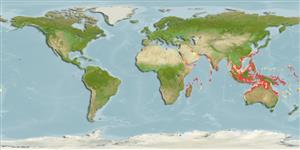
marino; salmastro associati a barriera corallina; oceanodromo (Ref. 51243); distribuzione batimetrica 1 - 50 m (Ref. 9813). Tropical; 30°N - 35°S, 49°E - 174°W
Indo-West Pacific: Persian Gulf, Gulf of Oman, Pakistan, India, Sri Lanka, Burma, Thailand, Singapore, Malaysia, Indonesia, Papua New Guinea, Philippines, Cambodia, Viet Nam, south China, Taiwan and Western Australia. Also known from Ryukyu Islands; Palau and Yap in Micronesia (Ref. 1602) and Melanesia (Ref. 712).
Lunghezza alla prima maturità / Dimensione / Peso / Età
Maturità: Lm 11.6, range 12 - ? cm
Max length : 40.0 cm TL maschio/sesso non determinato; (Ref. 108696); common length : 20.0 cm TL maschio/sesso non determinato; (Ref. 9813)
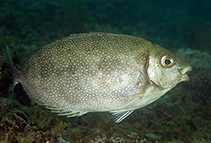
Spine dorsali (totale) : 13; Raggi dorsali molli (totale) : 10; Spine anali: 7; Raggi anali molli: 9; Vertebre: 23. This species is distinguished by the following characters: body compressed, moderately slender, its depth 2.3-2.8 in SL; last anal-fin spine 1.2-1.5 times in longest anal-fin spine (usually the third); soft parts of dorsal and anal fins low, longest dorsal-fin ray 0.7-1 times in longest dorsal-fin spine; caudal fin almost emarginate in specimens under 10 cm standard length, forked in larger fish; 16-26 (rarely 27) scale rows between lateral line and bases of leading dorsal-fin spines. Colour of body highly variable, greenish grey to yellow brown with numerous (100-200) pearly blue to whitish spots on nape and trunk, match-head size on lower sides; 2-3 rows between first spine of dorsal fin and lateral line (area of eye would cover about 6 spots in this region), and about 10 rows between highest point of lateral line and base of first anal-fin spine; when frightened or injured, sides mottled light and dark brown and cream, creating 6 or 7 regularly spaced, dark diagonal zones with paler zones of similar width between them; dark eye-sized spot usually just behind upper end of gill opening, and a narrow bar along upper edge of gill cover (Ref. 9813, 90102).
Body shape (shape guide): fusiform / normal; Cross section: compressed.
Adults inhabit inshore, algae reefs, estuaries and in large lagoons with algae-rubble habitats. Mainly common on rocky substrates (Ref. 48637). In contrast to S. fuscescens, this species seems to tolerate more turbid waters, occurring within the vicinity of river mouths especially around seagrass beds. Adults also occur several kilometers offshore in deep, clear waters. Juveniles form very large schools in shallow bays and coral reef flats; school size reduces with size, with adults occurring in groups of 20 individuals or so. Herbivorous, feed on benthic algae and to some extent on seagrass. Fished by trawling and seine netting; bycatch in traps set in deep water and marketed fresh in very large numbers (Ref. 9813). Consumed as food; and have poisonous spines (Ref. 4537).
Multiple spawner (Ref. 1753). Larger fish may spawn more than once in a spawning season (Ref. 1753). Spawn in group (Ref. 240).
Woodland, D.J., 1990. Revision of the fish family Siganidae with descriptions of two new species and comments on distribution and biology. Indo-Pac. Fish. (19):136 p. (Ref. 1419)
Stato della Lista Rossa IUCN (Ref. 130435: Version 2025-2 (Global))
Usi umani
Pesca: commerciale; Acquacoltura: commerciale
Strumenti
Rapporti speciali
Scarica XML
Fonti Internet
Stime basate su modelli
Temperatura preferita (Fonte Biblio.
123201): 24.7 - 29.1, mean 28.3 °C (based on 1218 cells).
Indice di diversità filogenetica (Fonte Biblio.
82804): PD
50 = 0.5000 [Uniqueness, from 0.5 = low to 2.0 = high].
Bayesian length-weight: a=0.01380 (0.01105 - 0.01725), b=2.99 (2.94 - 3.04), in cm total length, based on LWR estimates for this species (Ref.
93245).
Livello trofico (Fonte Biblio.
69278): 3.2 ±0.30 se; based on food items.
Generation time: 0.9 (0.6 - 2.6) years. Estimated as median ln(3)/K based on 11
growth studies.
Resilienza (Fonte Biblio.
120179): Medio, tempo minimo di raddoppiamento della popolazione 1.4 - 4.4 anni (K=1.5-2.0; tm=1; tmax=7.8).
Vulnerabilità della pesca (Ref.
59153): Low to moderate vulnerability (31 of 100).
🛈
Nutrienti (Ref.
124155): Calcium = 62.1 [27.3, 253.1] mg/100g; Iron = 1.48 [0.59, 3.82] mg/100g; Protein = 19.6 [17.9, 21.4] %; Omega3 = 0.15 [0.05, 0.50] g/100g; Selenium = 64.9 [15.3, 215.3] μg/100g; VitaminA = 7.95 [1.29, 45.87] μg/100g; Zinc = 2.44 [0.87, 5.78] mg/100g (wet weight);