Environnement : milieu / zone climatique / profondeur / gamme de distribution
Écologie
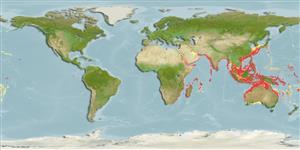
marin; eau douce; saumâtre démersal; catadrome (Ref. 51243); profondeur 20 - 350 m (Ref. 58488). Tropical; 26°C - 29°C (Ref. 4959); 36°N - 35°S, 20°E - 167°W
Indo-Pacific: Red Sea and East Africa to Samoa, north to southern Japan, south to the Arafura Sea (Ref. 9819), Australia, and Lord Howe Island.
Longueur à la première maturité / Taille / Poids / Âge
Maturité: Lm 13.0, range 9 - 17 cm
Max length : 36.0 cm TL mâle / non sexé; (Ref. 9710); common length : 25.0 cm SL mâle / non sexé; (Ref. 4967)
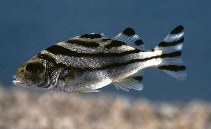
Épines dorsales (Total) : 11 - 12; Rayons mous dorsaux (Total) : 9 - 11; Épines anales: 3; Rayons mous anaux: 7 - 10. Diagnosis: This species is distinguished by the following characters: body oblong moderately and laterally compressed, greatest body depth 2.5-3.2 times in standard length; head length 2.3-2.6 times in standard length; lower opercular spine extending well beyond the opercular flap; posttemporal bone exposed and serrate posteriorly; pectoral fin rays 13-14; gill rakers 6-8 +13-16 = 19-24; pored lateral line scales 75-100; horizontal scale rows above lateral line 13-17; caudal fin emarginate (Ref. 48274, 90102).
Body shape (shape guide): fusiform / normal; Cross section: oval.
Found over shallow sandy bottoms, in the vicinity of river mouths. Enter estuaries and rivers (Ref. 1479, 11230, 44894, 48635), juveniles and adults are often found in freshwater (Ref. 4327). Adults in loose aggregations (Ref. 48635). Juveniles common in sandy intertidal areas; often in tidal pools. Minimum depth reported is 20 m (Ref. 12260). Found in schools (Ref. 9710). Omnivorous (Ref. 7300), feeding on fishes, insects, algae, and sand-dwelling invertebrates (Ref. 9710). Spawn in the sea and juveniles migrate into fresh water (Ref. 2847). Eggs are guarded and fanned by the male parent (Ref. 205). Produce sound (Ref. 9137). Caught on all types of inshore fishing gear including gill nets, traps, handlines, and bottom trawls and marketed fresh and dried-salted (Ref. 48274).
Eggs are guarded and fanned by the male parent (Ref. 205).
Paxton, J.R., D.F. Hoese, G.R. Allen and J.E. Hanley, 1989. Pisces. Petromyzontidae to Carangidae. Zoological Catalogue of Australia, Vol. 7. Australian Government Publishing Service, Canberra, 665 p. (Ref. 7300)
Statut dans la liste rouge de l'IUCN (Ref. 130435: Version 2025-2 (Global))
Menace pour l'homme
Harmless
Utilisations par l'homme
Pêcheries: intérêt commercial mineur; Aquaculture: commercial
Outils
Articles particuliers
Télécharger en XML
Sources Internet
Estimations basées sur des modèles
Température préférée (Réf.
123201): 17.6 - 27.9, mean 23.7 °C (based on 917 cells).
Indice de diversité phylogénétique (Réf.
82804): PD
50 = 0.6250 [Uniqueness, from 0.5 = low to 2.0 = high].
Bayesian length-weight: a=0.01549 (0.01258 - 0.01906), b=3.02 (2.96 - 3.08), in cm total length, based on LWR estimates for this species (Ref.
93245).
Niveau trophique (Réf.
69278): 3.9 ±0.5 se; based on diet studies.
Generation time: 4.6 ( na - na) years. Estimated as median ln(3)/K based on 2
growth studies.
Résilience (Réf.
120179): Milieu, temps minimum de doublement de population : 1,4 à 4,4 années (K=0.24).
Vulnérabilité de la pêche (Ref.
59153): Moderate vulnerability (37 of 100).
🛈
Nutriments (Ref.
124155): Calcium = 116 [71, 223] mg/100g; Iron = 1.11 [0.71, 1.75] mg/100g; Protein = 18.4 [17.5, 19.2] %; Omega3 = 0.306 [0.183, 0.494] g/100g; Selenium = 62.8 [32.1, 121.9] μg/100g; VitaminA = 37.9 [14.6, 97.9] μg/100g; Zinc = 1.19 [0.84, 1.68] mg/100g (wet weight);