>
Carangaria/misc (Various families in series Carangaria) >
Polynemidae (Threadfins)
Etymology: Leptomelanosoma: Greek, leptos = thin + Greek, melanos = black + Greek, soma = body.
More on author: Shaw.
Environnement : milieu / zone climatique / profondeur / gamme de distribution
Écologie
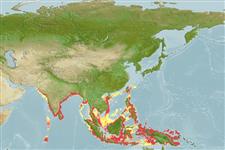
marin; saumâtre démersal; amphidrome (Ref. 51243); profondeur 55 - 100 m (Ref. 9685). Tropical; 26°N - 10°S, 62°E - 152°E (Ref. 57343)
Indo-West Pacific: known with certainty from Pakistan to Papua New Guinea. Reports from the east coast of Africa need to be verified (Ref. 57343).
Taille / Poids / Âge
Maturité: Lm ? range ? - ? cm
Max length : 142 cm TL mâle / non sexé; (Ref. 3479); common length : 80.0 cm TL mâle / non sexé; (Ref. 3479)
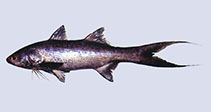
Épines dorsales (Total) : 9; Rayons mous dorsaux (Total) : 13 - 14; Épines anales: 2 - 3; Rayons mous anaux: 11 - 12. Golden olive in color, darker above, with faint dusky lines along body; fins yellowish (Ref. 5492).
Body shape (shape guide): elongated.
Occurs over shallow muddy and sandy bottoms of the continental shelf), mainly near estuaries and sometimes entering rivers (Ref. 57343). Feeds mainly on small benthic crustaceans, especially prawns and crabs, and small fishes. Percentage of fishes eaten increases with size. Utilized fresh, dried or salted and frozen; eaten steamed, pan-fried, broiled and baked (Ref. 9987).
Cycle de vie et comportement reproducteur
Maturité | Reproduction | Frai | Œufs | Fécondité | Larves
Motomura, H. and Y. Iwatsuki, 2001. A new genus, Leptomelanosoma, for the polynemid fish previously known as Polydactylus indicus (Shaw, 1804) and a redescription of the species. Ichthyol. Res. 48(1):13-21. (Ref. 45350)
Statut dans la liste rouge de l'IUCN (Ref. 130435: Version 2025-2 (Global))
Menace pour l'homme
Harmless
Utilisations par l'homme
Pêcheries: commercial; pêche sportive: oui
Outils
Articles particuliers
Télécharger en XML
Sources Internet
Estimations basées sur des modèles
Température préférée (Réf.
123201): 23.7 - 28.1, mean 26.3 °C (based on 82 cells).
Indice de diversité phylogénétique (Réf.
82804): PD
50 = 1.0000 [Uniqueness, from 0.5 = low to 2.0 = high].
Bayesian length-weight: a=0.00479 (0.00278 - 0.00823), b=3.09 (2.93 - 3.25), in cm total length, based on LWR estimates for this species & (Sub)family-body (Ref.
93245).
Niveau trophique (Réf.
69278): 3.9 ±0.67 se; based on food items.
Generation time: 5.8 ( na - na) years. Estimated as median ln(3)/K based on 1
growth studies.
Résilience (Réf.
120179): Milieu, temps minimum de doublement de population : 1,4 à 4,4 années (K=0.19).
Vulnérabilité de la pêche (Ref.
59153): High vulnerability (60 of 100).
🛈
Nutriments (Ref.
124155): Calcium = 44.4 [16.8, 164.2] mg/100g; Iron = 0.51 [0.19, 1.46] mg/100g; Protein = 19.8 [18.0, 21.4] %; Omega3 = 0.143 [0.081, 0.241] g/100g; Selenium = 83.8 [45.1, 159.8] μg/100g; VitaminA = 9.34 [4.42, 19.15] μg/100g; Zinc = 1.37 [0.51, 2.69] mg/100g (wet weight); based on
nutrient studies.