Entorno: milieu / zona climática / rango de profundidad / gama de distribución
Ecología
; agua dulce; salobre bentopelágico; pH range: 7.0 - 7.5; dH range: 10 - 20; potamodromo. Temperate; 2°C - 18°C (Ref. 1672); 67°N - 36°N, 10°W - 142°E
Europe: Atlantic Ocean, North and Baltic Sea basins, from Loire drainage eastward, eastern Great Britain, Rhône and Volga drainages, upper Danube and middle and upper Dniestr and Dniepr drainages; in Finland, north to about 61°N. Introduced to eastern and northern Italy, Ireland, Wales and Scotland. Eastern and southern limits unclear (Ref. 59043). Occurs as far east as Korea (Ref. 4537). Populations from the Iberian Peninsula and Adour basin in southern France refer to G. lozanoi (Ref. 57030). Populations from the Caspian basin may represent a distinct species (Ref. 59043).
Longitud en la primera madurez / Tamaño / Peso / Edad
Madurez: Lm 9.3 range ? - ? cm
Max length : 21.0 cm TL macho / no sexado; (Ref. 88166); common length : 12.0 cm TL macho / no sexado; (Ref. 6258); peso máximo publicado: 220.00 g (Ref. 6258); edad máxima reportada: 8 años (Ref. 6258)
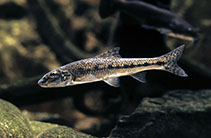
Espinas dorsales (total) : 2 - 3; Radios blandos dorsales (total) : 5 - 7; Espinas anales: 2 - 3; Radios blandos anales: 6 - 8; Vértebra: 39 - 41. Diagnosed from other congeners in Europe by the possession of the following characters: barbel reaching beyond anterior eye margin, usually to middle of eye; snout length greater than postorbital distance; head length 26-30% SL; eye diameter 5-7% SL; 1.0-1.4 times in interorbital distance in over about 6 cm SL specimens (less in smaller ones), 2.4-2.8 times in head depth; head depth 15-17% SL at nape, 43-51% HL at eye; body depth 19-23% SL; head width 14-16% SL, 49-57% HL; caudal peduncle depth 30-34% HL; breast naked between pectorals; scales between anus and anal origin 4-5; scales on lateral line usually 39-42 + 2; and scales around caudal peduncle usually 12-14 (Ref. 59043). Caudal fin with 19 rays (Ref. 2196). Scalar formula: 38-45 (Ref. 40476).
Body shape (shape guide): fusiform / normal.
Occurs in nearly all types of riverine and lacustrine habitats with sand bottom. Found in small mountain streams, large lowland rivers and large lakes (Ref. 59043). Inhabits fast flowing rivers with sand or gravel bottom but may also occur in still waters. Forms schools. Feeds on insect larvae, mollusks, and crustaceans. Normally active during the day but if they are disturbed, in particular, by predators, they can defer their activity to periods when light intensity is weak. Capable of emitting squeaking sounds. These vocalizations, which is a means by which fish communicate with each other, vary with the degree of activity and the temperature and are independent of the season of reproduction (Ref. 30578). Breeds in shallow water over stones, sand or plant material. Eggs are released above substrate and drift with current, sinking to bottom and sticking to substrate. Larvae and juveniles occur on the bottom and prefer detritus-rich sandy habitats and low current (Ref. 59043).
Spawns once a year for several years in low productivity streams, but exhibits multiple spawning within a season in high productivity environments (Ref. 40290, 40756). Releases eggs above substrate which drift with current, sink to the bottom and stick to substrate. Larvae and juveniles occur on the bottom and prefer detritus-rich sandy habitats and low current (Ref. 59043).
Kottelat, M. and J. Freyhof, 2007. Handbook of European freshwater fishes. Publications Kottelat, Cornol and Freyhof, Berlin. 646 pp. (Ref. 59043)
Situación en la Lista Roja de la UICN (Ref. 130435: Version 2025-2 (Global))
Amenaza para el ser humano
Harmless
Usos humanos
Pesquerías: comercial; Acuario: Comercial; carnada: usually
Herramientas
Informes especiales
Descargar XML
Fuentes de Internet
Estimaciones basadas en modelos
Índice de diversidad filogenética (Referencia
82804): PD
50 = 0.5000 [Uniqueness, from 0.5 = low to 2.0 = high].
Bayesian length-weight: a=0.00708 (0.00614 - 0.00817), b=3.12 (3.08 - 3.16), in cm total length, based on LWR estimates for this species (Ref.
93245).
Nivel trófico (Referencia
69278): 3.1 ±0.38 se; based on food items.
Resiliencia (Referencia
120179): Medio, población duplicada en un tiempo mínimo de 1.4-4.4 años (tm=1-3; tmax=8; Fec=1,000-3,000).
Vulnerabilidad pesquera (Ref.
59153): Low to moderate vulnerability (31 of 100).
🛈