>
Carangaria/misc (Various families in series Carangaria) >
Latidae (Lates perches)
Etymology: Lates: Latin, lateo, latere = to be hidden.
More on author: Boulenger.
Entorno: milieu / zona climática / rango de profundidad / gama de distribución
Ecología
; agua dulce demersal; pH range: 7.5 - 8.2; dH range: 20 - 40; no migratorio (Ref. 126106). Tropical; 22°C - 28°C (Ref. 12468); 3°S - 9°S
Africa: widely distributed in Lake Tanganyika (Ref. 2216, 36901) and present in the Malagarazi River delta (Ref. 54847).
Longitud en la primera madurez / Tamaño / Peso / Edad
Madurez: Lm 56.5 range ? - ? cm
Max length : 200 cm SL macho / no sexado; (Ref. 4967); peso máximo publicado: 100.0 kg (Ref. 58490)
Descripción breve
Claves de identificación | Morfología | Morfometría
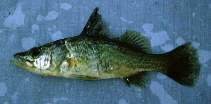
Spacing between dorsal fins more than between last spines of first dorsal fin. Caudal fin rounded in adults, rounded and spotted in juveniles. Eyes small, less than interorbital with.
Body shape (shape guide): fusiform / normal; Cross section: compressed.
Juveniles live in a specific inshore habitat until they reach 18 cm (Ref. 2216) also found near and in slow flowing affluents (Ref. 36901). Adults found from the littoral to near the limit of the oxygenated zone (Ref. 2216). Solitary, lurking predator, probably favoring rocky bottoms and unspecialized in its fish diet; highly susceptible to intensive fishing (Ref. 2216). They feed largely on benthic cichlids (Ref. 4967, 36901), but also takes sardines (Ref. 4967). Threatened due to over harvesting (Ref. 58490).
Ciclo vital y comportamiento de apareamiento
Madurez | Reproducción | Puesta | Huevos | Fecundidad | Larva
Coulter, G.W., 1976. The biology of Lates species in Lake Tanganyika, and the status of the pelagic fishery for Lates species and Luciolates stapersii. J. Fish Biol. 9(3):235-259. (Ref. 2216)
Situación en la Lista Roja de la UICN (Ref. 130435: Version 2025-2 (Global))
Amenaza para el ser humano
Harmless
Usos humanos
Pesquerías: comercial; pesca deportiva: si
Herramientas
Informes especiales
Descargar XML
Fuentes de Internet
Estimaciones basadas en modelos
Índice de diversidad filogenética (Referencia
82804): PD
50 = 0.5005 [Uniqueness, from 0.5 = low to 2.0 = high].
Bayesian length-weight: a=0.01096 (0.00638 - 0.01885), b=3.02 (2.87 - 3.17), in cm total length, based on LWR estimates for this species & Genus-body shape (Ref.
93245).
Nivel trófico (Referencia
69278): 4.5 ±0.80 se; based on food items.
Generation time: 4.4 ( na - na) years. Estimated as median ln(3)/K based on 1
growth studies.
Resiliencia (Referencia
120179): Bajo, población duplicada en un tiempo mínimo de 4.5-14 años (tm=3-5; K=0.25; tmax=13).
Vulnerabilidad pesquera (Ref.
59153): Moderate to high vulnerability (55 of 100).
🛈
Nutrientes (Ref.
124155): Calcium = 111 [25, 234] mg/100g; Iron = 1.46 [0.72, 3.44] mg/100g; Protein = 20 [19, 22] %; Omega3 = 0.386 [0.157, 0.959] g/100g; Selenium = 215 [57, 655] μg/100g; VitaminA = 17.9 [4.1, 96.2] μg/100g; Zinc = 0.694 [0.286, 1.525] mg/100g (wet weight);