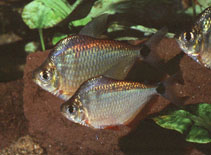
>
Characiformes (Characins) >
Characidae (Characins; tetras) > Tetragonopterinae
Etymology: Tetragonopterus: Name from Greek words: 'Tetra' meaning four; 'gonia' meaning angle; 'pteron' for fin; referring to the evident tetragonal shape of the body (Ref. 124043).
More on author: Cuvier.
Lingkungan: lingkungan / zona iklim / kisaran kedalaman / jangkauan distribusi
Ekologi
; air tawar pelagis, permukaan; pH range: 5.8 - 8.5; dH range: ? - 30. Tropical; 22°C - 27°C (Ref. 1672)
South America: Amazon basin, upper Essequibo, Orinoco, Parnaíba, Jaguaribe, Paraguay and lower Paraná river basins.
Ukuran / Berat / umur
Kematangan: Lm ? range ? - ? cm
Max length : 11.2 cm SL jantan/; (Ref. 79891)
duri punggung lunak (Keseluruhan (total)) : 9; Sirip dubur lunak: 28 - 40; vertebrata, bertulang belakang: 27. This species is distinguished from all its congeners by the following characters: predorsal scales 11-17 (vs. 7-9); differs from T. anostomus, T. denticulatus, T. kuluene, T. juruena by the principal teeth in dentary 4 (vs. 5-6), and larger and more robust teeth (vs. thinner and sharper); differs from T. anostomus, T. araguaiensis by the number of gill-rakers on the upper limb of the first gill arch 12-15 (vs.17-20); differs from T. anostomus by having a terminal mouth (vs. subsuperior mouth); differs from T. ommatus the maxillary teeth 1-4 (vs. 7-8) and by the presence of a conspicuous dark mark on the caudal peduncle (vs. inconspicuous mark limited to the posterior portion of the caudal peduncle); differs from T. carvalhoi by having a rounded dark mark on the caudal peduncle (vs. lozenge-shaped dark mark on the caudal peduncle); differs from T. rarus by the absence of dark longitudinal stripes on the trunk (vs. presence of such stripes); differs from T. rarus, T. georgiae having the scale rows between lateral line and pelvic-fin origin 3.5 (vs. 4.5-5.5); differs from T. denticulatus by having humeral marks separated by one or two vertical rows of scales (vs. humeral marks separated by three vertical scale rows) (Ref. 124043).
Cross section: compressed.
Consumed locally for recovery or during illness. Carnivorous (Ref. 42843).
Siklus hidup dan perilaku kawin
Kematangan | Reproduksi, perkembang biakan | Pemijahan | telur-telur | Fekunditas | Larva
Is being bred in Asia and Florida in ponds (Ref. 1672).
Silva, G.S.C., B.F. Melo, C. Oliveira and R.C. Benine, 2016. Revision of the South American genus Tetragonopterus Cuvier, 1816 (Teleostei: Characidae) with description of four new species. Zootaxa 4200(1):1-46. (Ref. 124043)
Status IUCN Red List (Ref. 130435: Version 2025-2 (Global))
ancaman kepada manusia
Harmless
penggunaan manusia
Perikanan: komersial; Akuarium: Komersial
Alat, peralatan
laporan khas
muat turun XML
Sumber internet
Estimasi berdasarkan model
Indeks keanekaragaman filogenetik (Acuan
82804): PD
50 = 0.5000 [Uniqueness, from 0.5 = low to 2.0 = high].
Bayesian length-weight: a=0.03162 (0.01767 - 0.05660), b=2.98 (2.83 - 3.13), in cm total length, based on LWR estimates for this species & Genus-body shape (Ref.
93245).
Tingkat Trofik (Acuan
69278): 3.6 ±0.4 se; based on size and trophs of closest relatives
Kerentanan Penangkapan Ikan (Ref.
59153): Low vulnerability (10 of 100).
🛈