>
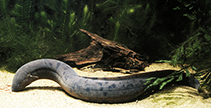
Ceratodontiformes (Australian lungfishes) >
Lepidosirenidae (Aestivating lungfishes)
Etymology: Lepidosiren: Greek, lepis = scale + Greek, seiren = a mythological serpent, 1520 (Ref. 45335).
Ambiente: milieu / zona climatica / distribuzione batimetrica / gamma di distribuzione
Ecologia
; acqua dolce demersale. Subtropical; 24°C - 28°C (Ref. 2060); 5°N - 35°S
South America: Amazon, Paraguay and lower Paraná River basins.
Dimensione / Peso / Età
Maturità: Lm ? range ? - ? cm
Max length : 125 cm TL maschio/sesso non determinato; (Ref. 36887); Età massima riportata: 8 anni (Ref. 274)
Obligate air-breathing (Ref. 126274); Prefers stagnant waters where there is little current. Juveniles feed on larval insects and snails. Adults are omnivorous and feed on aquatic vertebrates, invertebrates such as snails, clams and shrimp, and algae (Ref. 36739). Can survive low oxygen levels in its habitat by means of its very reduced branchial apparatus. It possesses two lungs without bronchial tubes. During the dry period, this species burrows into the mud, to a depth of about 30-50 cm, and seals off the entrance with clay, leaving out 2-3 holes for aeration. It reduces its metabolism during this period of hibernation. The fish are obligate air-breathers and will drown if denied access to the surface (Ref. 36739). During the rainy season, reproduction begins. The parents gather vegetal debris in a burrow (about 1.5 m long) to create a nest. During reproduction, males guard the young. These males can increase the oxygen level in the burrow because during breading season the pelvic fins develop highly vascularized, gill-like, feathery structures which perform a function opposite to those of gills: they releases oxygen from the blood and take in carbon dioxide; the filaments disappear after the end of the breeding season (Ref. 12225, 36739). The young look like amphibian tadpoles with four external gills. During the first weeks of their life they breath only through the external gills; at an age of 7 weeks they become air-breathing and regression of the external gills begins (Ref. 27188, 36739).
Ciclo vitale e comportamento di accoppiamento
Maturità | Riproduzione | Deposizione | Uova | Fecondità | Larve
Spawning occurs during the wet season. Adult males guard and aerate the hachlings and young temporarily. Adult males develop vascular filaments on their paired fins which function either as auxillary to respiration so that they can breathe air without leaving the nest or the fin filaments permit the emission of aerially obtained oxygen in to the nest water, causing the oxygenation of the water surrounding the eggs (Ref. 111170). The function of the filaments is much debatable as of the present.
Arratia, G., 2003. Lepidosirenidae (aestivating lungfishes). p. 671-672. In R.E. Reis, S.O. Kullander and C.J. Ferraris, Jr. (eds.) Checklist of the Freshwater Fishes of South and Central America. Porto Alegre: EDIPUCRS, Brasil. (Ref. 36887)
Stato della Lista Rossa IUCN (Ref. 130435: Version 2025-2 (Global))
Minaccia per l'uomo
Harmless
Usi umani
Pesca: pesca di sussistenza
Strumenti
Rapporti speciali
Scarica XML
Fonti Internet
Stime basate su modelli
Indice di diversità filogenetica (Fonte Biblio.
82804): PD
50 = 1.5312 [Uniqueness, from 0.5 = low to 2.0 = high].
Bayesian length-weight: a=0.00389 (0.00180 - 0.00842), b=3.12 (2.94 - 3.30), in cm total length, based on all LWR estimates for this body shape (Ref.
93245).
Livello trofico (Fonte Biblio.
69278): 3.1 ±0.46 se; based on food items.
Resilienza (Fonte Biblio.
120179): Molto basso, tempo minimo di raddoppiamento della popolazione più di 14 anni (tmax > 22; Fec = 22).
Vulnerabilità della pesca (Ref.
59153): High to very high vulnerability (75 of 100).
🛈