>
Ceratodontiformes (Australian lungfishes) >
Neoceratodontidae (Australian lungfish)
Etymology: Neoceratodus: Greek, neos = new + Greek, keras = horn + Greek, odous = teeth (Ref. 45335).
Eponymy: William Forster (1818–1882) was an Australian farmer, journalist, magistrate, poet and politician (1856–1876) who was Premier of New South Wales (1859–1860) once described by a fellow politician as: “disagreeable in opposition, insufferable as a [...] (Ref. 128868), visit book page.
Môi trường: môi trường / vùng khí hậu / Mức độ sâu / phạm vi phân phối
Sinh thái học
; nước ngọt gần đáy; di cư trong nước ngọt (Ref. 51243). Tropical; 22°C - 28°C (Ref. 2060); 24°S - 26°S
Oceania: southern Queensland, Australia in Burnett and Mary River systems. Introduced successfully in southeastern Queensland.
Chiều dài lúc trưởng thành đầu tiên / Bộ gần gũi / Khối lượng (Trọng lượng) / Tuổi
Chín muồi sinh dục: Lm 83.4, range 81 - ? cm
Max length : 170 cm TL con đực/không giới tính; (Ref. 26188); common length : 100.0 cm TL con đực/không giới tính; (Ref. 5259); Khối lượng cực đại được công bố: 40.0 kg (Ref. 5259)
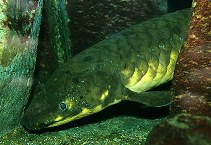
Các tia vây lưng cứng (tổng cộng) : 0; Các vây lưng mềm (tổng cộng) : 0; Tia cứng vây hậu môn: 0; Tia mềm vây hậu môn: 0. Body stout and elongate. Dorsal fin originating on the middle of the back, confluent with caudal and anal fins. Body covered with large, bony, overlapping scales. The head is flattened, with conical profile. The eyes are small; the mouth is reaching about half the distance to eye. The pectoral fins are large and flipper-like in ventral position just behind the head; the pelvic fins are also flipper-like, situated far back on the body.
Body shape (shape guide): elongated; Cross section: circular.
Inhabits mud, sand or gravel bottoms (Ref. 44894). Sluggish species that prefers still or slow-flowing waters, usually in deep pools. During period of drought, it can tolerate stagnant conditions by breathing air, surfacing 1-2 times per hour; however, it lacks the ability to survive dry spells by aestivation; it is a facultative air-breather that will die if forced to depend on air breathing (Ref. 36739, 44894). The sound of the lungfish exhaling air at the surface prior to inhaling a fresh breath has been likened to that made by a small bellows. Nocturnally active (Ref. 44894). Feeds on frogs, tadpoles, fishes, shrimp, earthworms, snails, aquatic plants and native fruits fallen from trees overhanging the creeks (Ref. 36739, 44894). It browses among the detritus, using its electroreceptors to pick up hidden mollusks, worms or crustaceans. Protected by law. Fossil records show that this species remained virtually unchanged for over 380 million years. The Steinhart Aquarium in San Francisco had a specimen of 1 m length, 20 kg weight, and more than 65 years of age. In 1933, an Australian lungfish was transported as a fully mature male (10 yrs. old at maturity) to the Shedd Aquarium, Chicago (C. Skonieczny, pers. comm. 11/08, e-mail: CSkonieczny@sheddaquarium.org). But this fish named Granddad, died in 2017 at the age of 95 (Ref 125841). By default, another individual which was brought to the California Academy of Sciences Aquarium in 1938 from Australia becomes the oldest at the age of 90 years. Biologists at the aquarium believe that Methuselah, as it is fondly called, is a female which measures 120 m and weighs 18,100 g (Ref. 125841).
The lungfish spawns from August to October; the eggs resemble small transparent grapes and are frequently found attached to floating stands of water-hyacinth. Spawning appears to occur in a series of three phases: in the first, a pair of fish move together, roaming about an area, presumably in search of a suitable spawning site; in the second presumably the male follows the female, nudging her flanks; finally, the fish plunge through the surrounding weed, the male following the female and fertilising the eggs as they are shed.
Allen, G.R., 1989. Freshwater fishes of Australia. T.F.H. Publications, Inc., Neptune City, New Jersey. (Ref. 5259)
Tình trạng Sách đỏ IUCN (Ref. 130435: Version 2025-2 (Global))
Mối đe dọa đối với con người
Harmless
Sử dụng của con người
Các nghề cá: các nghề cá là sinh kế
Các công cụ
Báo cáo đặc biệt
Tải xuống XML
Các nguồn internet
Ước tính dựa trên mô hình
Chỉ số đa dạng phát sinh loài (Tài liệu tham khảo
82804): PD
50 = 1.5312 [Uniqueness, from 0.5 = low to 2.0 = high].
Bayesian length-weight: a=0.00389 (0.00180 - 0.00842), b=3.12 (2.94 - 3.30), in cm total length, based on all LWR estimates for this body shape (Ref.
93245).
Mức dinh dưỡng (Tài liệu tham khảo
69278): 3.4 ±0.54 se; based on food items.
Generation time: 10.3 ( na - na) years. Estimated as median ln(3)/K based on 2
growth studies.
Thích nghi nhanh (Tài liệu tham khảo
120179): Rất thấp, thời gian nhân đôi của chủng quần tối thiểu là hơn 14 năm (K=0.11; tmax >30; tm approx. 15-20 yrs.).
Sự dễ bị tổn thương của nghề đánh cá (Ref.
59153): High to very high vulnerability (72 of 100).
🛈