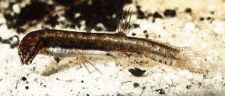
Klassifizierung / Names
Namen | Synonyme | Catalog of Fishes(Gattung, Arten) | ITIS | CoL | WoRMS | Cloffa
Umwelt: Milieu / Klimazone / Tiefenbereich / Verbreitungsgebiet
Ökologie
; süßwasser demersal; pH range: 3.8 - 4.5; dH range: 5 - ?; standorttreu. Temperate; 17°C - 26°C (Ref. 36498); 34°S - 35°S
Oceania: endemic to Western Australia in seasonal pools between the Blackwood and Kent rivers.
Länge bei der ersten Reifung / Größe / Gewicht / Alter
Geschlechtsreife: Lm 4.3 range ? - ? cm
Max length : 7.4 cm SL Männchen/unbestimmt; (Ref. 44894); 6.7 cm TL (female); common length : 4.0 cm SL Männchen/unbestimmt; (Ref. 5259)
Facultative air-breathing (Ref. 126274); Occurs in shallow streams, drains and temporary pools in generally acidic water around pH 4. Water typically is tea-coloured (Ref. 44894). Feeds mainly on aquatic insect larvae and small crustaceans. Spawn: late winter, early spring; internal fertilization (male with modified anal fin); female laying about 100 eggs. Rapid growth of hatchlings (reaching 2.5 cm by summer). Life cycle may be limited to 12 months. Young fish aestivates in pear-shaped burrow in mud until water returns in autumn. They have no accessory respiratory structures and cannot withstand low oxygen situations (Ref. 36499). About 25-30% of the population attains sexual maturity at the end of the first year. The breeding season coincides with heavy rains between late May and August. The lifespan typically lasts three years, but some fish persist for up to five years (Ref. 44894).
Internal fertilization is facilitated by the modified anal fin of the male. Female deposits about 100 eggs in the shallows.
Berra, T.M. and G.R. Allen, 1991. Population structure and development of Lepidogalaxias salamandroides (Pisces: Salmoniformes) from western Australia. Copeia 1991(3):845-850. (Ref. 36498)
IUCN Rote Liste Status (Ref. 130435: Version 2025-2 (Global))
Bedrohung für Menschen
Harmless
Nutzung durch Menschen
Fischereien: nicht kommerziell
Tools
Zusatzinformationen
Download XML
Internet Quellen
Schätzungen auf der Grundlage von Modellen
Phylogenetischer Diversitätsindex (Ref.
82804): PD
50 = 2.0000 [Uniqueness, from 0.5 = low to 2.0 = high].
Bayesian length-weight: a=0.00389 (0.00180 - 0.00842), b=3.12 (2.94 - 3.30), in cm total length, based on all LWR estimates for this body shape (Ref.
93245).
Trophische Ebene (Ref.
69278): 3.1 ±0.4 se; based on diet studies.
Generation time: 1.7 ( na - na) years. Estimated as median ln(3)/K based on 2
growth studies.
Widerstandsfähigkeit (Ref.
120179): niedrig, Verdopplung der Population dauert 4,5 - 14 Jahre. (Fec = 37).
Anfälligkeit der Fischerei (Ref.
59153): Low to moderate vulnerability (27 of 100).
🛈