>
Eupercaria/misc (Various families in series Eupercaria) >
Nemipteridae (Threadfin breams, Whiptail breams)
Etymology: Nemipterus: Greek, nema, -atos = filament + Greek, pteron = wing, fin (Ref. 45335).
More on author: Bloch.
Environnement : milieu / zone climatique / profondeur / gamme de distribution
Écologie
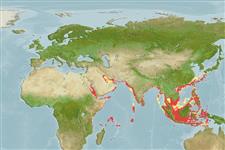
marin démersal; non migrateur; profondeur 5 - 80 m (Ref. 9785). Tropical; 34°N - 11°S, 31°E - 133°E (Ref. 3810)
Indo-Pacific.
Longueur à la première maturité / Taille / Poids / Âge
Maturité: Lm 18.3 range ? - ? cm
Max length : 34.0 cm TL mâle / non sexé; (Ref. 124816); common length : 25.0 cm TL mâle / non sexé; (Ref. 5450); poids max. publié: 596.00 g (Ref. 1448); âge max. reporté: 8 années (Ref. 1448)
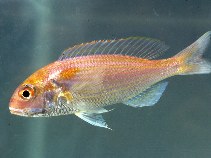
Épines dorsales (Total) : 10; Rayons mous dorsaux (Total) : 9; Épines anales: 3; Rayons mous anaux: 7. This species is distinguished by the following characters: lower margin of eye above a line from tip of snout to upper base of pectoral fins; a line drawn up from the posterior edge of suborbital reaching the dorsal profile 2 to 4 scale rows before origin of dorsal fin; pectoral fins very long, 1-1.3 in HL, reaching to or just beyond level of origin of anal fin; pelvic fins moderately long, 1.2-1.6 in HL, reaching to or just beyond anus; caudal fin moderately forked, upper lobe slightly longer than lower and produced into a short or moderately long filament. Colour: upper part of body pinkish, becoming silvery below; top of head behind eye with a golden sheen; 11-12 pale golden-yellow stripes along body from behind head to base of caudal fin; a prominent red-suffused yellow blotch below origin of lateral line; dorsal fin whitish, margin of fin yellow, edged with red; a pale lemon stripe near base of dorsal fin, this stripe narrow anteriorly and widening on posterior part of fin; anal fin whitish with pale lemon broken lines or scribblings over most of fin; caudal fin pink, upper tip and filament yellow (Ref. 9785).
Body shape (shape guide): fusiform / normal; Cross section: oval.
Very abundant in coastal waters, found on mud or sand bottoms, usually in schools. Feeds mainly on small fishes, crustaceans, mollusks (mainly cephalopods), polychaetes and echinoderms. Marketed mainly fresh, but also frozen, steamed, dried-salted, dry-smoked, fermented or made into fish balls and fish meal.
Females predominate at small sizes and males at larger sizes, due to faster growth rate in males (Ref. 6254).
Russell, B.C., 1990. FAO Species Catalogue. Vol. 12. Nemipterid fishes of the world. (Threadfin breams, whiptail breams, monocle breams, dwarf monocle breams, and coral breams). Family Nemipteridae. An annotated and illustrated catalogue of nemipterid species known to date. FAO Fish. Synop. 125(12):149p. Rome: FAO. (Ref. 3810)
Statut dans la liste rouge de l'IUCN (Ref. 130435: Version 2025-2 (Global))
Menace pour l'homme
Harmless
Utilisations par l'homme
Pêcheries: commercial
Outils
Articles particuliers
Télécharger en XML
Sources Internet
Estimations basées sur des modèles
Température préférée (Réf.
123201): 24.7 - 29.2, mean 28.4 °C (based on 1310 cells).
Indice de diversité phylogénétique (Réf.
82804): PD
50 = 0.5000 [Uniqueness, from 0.5 = low to 2.0 = high].
Bayesian length-weight: a=0.01413 (0.01234 - 0.01617), b=2.96 (2.93 - 2.99), in cm total length, based on LWR estimates for this species (Ref.
93245).
Niveau trophique (Réf.
69278): 4.2 ±0.81 se; based on food items.
Generation time: 1.9 (1.7 - 2.1) years. Estimated as median ln(3)/K based on 65
growth studies.
Résilience (Réf.
120179): Milieu, temps minimum de doublement de population : 1,4 à 4,4 années (K=0.29-1.06; tm= 0.5-1.4; tmax=8; Fec = 13,900).
Prior r = 0.58, 95% CL = 0.38 - 0.86, Based on 1 full stock assessment.
Vulnérabilité de la pêche (Ref.
59153): Low vulnerability (21 of 100).
🛈
Vulnérabilité climatique (Ref.
125649): High vulnerability (57 of 100).
🛈
Nutriments (Ref.
124155): Calcium = 452 [102, 857] mg/100g; Iron = 1.47 [0.45, 3.98] mg/100g; Protein = 18 [16, 20] %; Omega3 = 0.276 [0.133, 0.605] g/100g; Selenium = 40.4 [15.7, 122.5] μg/100g; VitaminA = 13.5 [3.1, 72.7] μg/100g; Zinc = 0.679 [0.387, 2.339] mg/100g (wet weight); based on
nutrient studies.