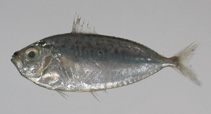
Taxonomic Remarks
nomen dubium: Sparks (2006) indicated that the designation of the lectotype(s) by Jones (1985) and Bauchot and Desoutter (1989) must be invalid because the lectotype was probably chosen from incorrect syntypes (see ICZN 1999: MNHN A.6738 with 2 specimens, MNHN A.6739, MNHN 1988-397, and MNHN 1988-328 measure too small, 26-46 mm SL, and are not correct syntypes). Valenciennes in Cuvier and Valenciennes 1835 stated clearly in the original description of Equula lineolata, ‘‘Nos individus sont longs de trois pouces (Our specimens are three inches in length)’’. Thus, the lectotype(s) designated are totally invalid, and it is impossible to identify Equula lineolata accurately for no type specimens could be found and the original description was incomplete (Ref. 120651).
Entorno: milieu / zona climática / rango de profundidad / gama de distribución
Ecología
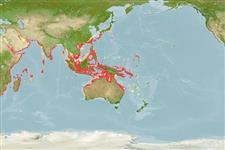
marino demersal; rango de profundidad 20 - 50 m (Ref. 28016). Tropical; 36°N - 31°S, 30°E - 169°E
Indo-West Pacific: Durban, South Africa (Ref. 11228), Madagascar and Pakistan to the Philippines, north to southern Japan (Ref. 559), south to northeast Australia.
Tamaño / Peso / Edad
Madurez: Lm ? range ? - ? cm
Max length : 15.0 cm TL macho / no sexado; (Ref. 5450)
Found in coastal waters. Stays near the substrate and feeds on fish, crustaceans, chaetognaths, nematodes, bivalves, and gastropods (Ref. 5213).
Ciclo vital y comportamiento de apareamiento
Madurez | Reproducción | Puesta | Huevos | Fecundidad | Larva
James, P.S.B.R., 1984. Leiognathidae. In W. Fischer and G. Bianchi (eds.) FAO species identification sheets for fishery purposes. Western Indian Ocean (Fishing Area 51). Vol. 2. FAO, Rome. pag. var. (Ref. 3424)
Situación en la Lista Roja de la UICN (Ref. 130435: Version 2025-2 (Global))
Amenaza para el ser humano
Harmless
Usos humanos
Pesquerías: comercial
Herramientas
Informes especiales
Descargar XML
Fuentes de Internet
Estimaciones basadas en modelos
Temperatura preferida (Referencia
123201): 24.1 - 28.6, mean 27.6 °C (based on 318 cells).
Índice de diversidad filogenética (Referencia
82804): PD
50 = 0.5002 [Uniqueness, from 0.5 = low to 2.0 = high].
Bayesian length-weight: a=0.00661 (0.00446 - 0.00978), b=3.17 (3.06 - 3.28), in cm total length, based on LWR estimates for this species (Ref.
93245).
Nivel trófico (Referencia
69278): 3.5 ±0.50 se; based on food items.
Resiliencia (Referencia
120179): Alto, población duplicada en un tiempo mínimo inferior a 15 meses (K=1.05-2.83).
Vulnerabilidad pesquera (Ref.
59153): Low vulnerability (13 of 100).
🛈