>
Lophiiformes (Anglerfishes) >
Neoceratiidae (Toothed seadevils)
Etymology: Neoceratias: Named by Pappenheim (1914:198) to signify a new kind of ceratiid-like anglerfish, at the time expressing uncertainty of its position within the suborder but finding great similarity with the Ceratiidae. (Ref. 86949).
Umwelt: Milieu / Klimazone / Tiefenbereich / Verbreitungsgebiet
Ökologie
seewasser demersal; tiefenbereich 0 - 1200 m (Ref. 58302). Deep-water
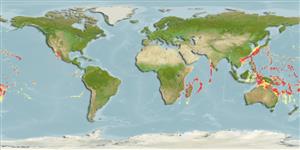
Western Central Pacific.
Größe / Gewicht / Alter
Geschlechtsreife: Lm ? range ? - ? cm
Max length : 6.0 cm TL Männchen/unbestimmt; (Ref. 557)
Kurzbeschreibung
Bestimmungsschlüssel | Morphologie | Morphometrie
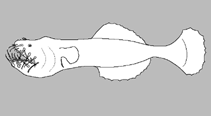
Rückenflossenweichstrahlen (insgesamt) : 10 - 13; Afterflossenweichstrahlen: 10 - 13. Metamorphosed females distinguished by the following characteristics: lacks illicium and second cephalic spine, as well as cranial trough, within which pterygiophore of illicium lies in all other female ceratioids; broad and roughly rectangular shaped frontals; absence of metapterygoid and mesopterygoid; usually short and nearly straight preopercle; usually thick and well developed premaxillae and dentaries, with rounded edges; presence of a pair of prominent nasal papillae on snout; inner margin of jaws bearing single inner row of small immobile teeth; outer margin bears 2-3 series of long hinged teeth, each with tiny distal hook; dorsal and anal fins mounted on prominent bases; presence of supraethmoid; frontals without ventromedial extensions, meet on midline; presence of parietals; conical shaped sphenotics, without distal spine; presence of pterosphenoid; hyomandibula with single head; 2 hypohyals and 6 (2+4), rarely 5 (1+4), branchiostegal rays; bifuctaed and very much reduced opercle; reduced subopercle, long and narrow, as long as or slightly longer than lower fork of opercle, without posterior notch; ventral part without spine or projection on anterior margin; quadrate, articular, angular and preopercular spines absent; jaws subequal, lower extending anteriorly beyond upper; lower jaw lacking symphisial spine; absence postmaxillary process of premaxilla and anterior-maximandibular ligament; absence of first, second and fourth pharyngobranchial, third is well developed and toothed; single ossified hypobranchial; absence of ossified basibranchials; absence of epibranchial and ceratobranchial; epurals absent; deeply notched posterior margin of hypural plate; pterygiophore of illicium fully embedded in skin of head; esca absent; coracoid lacking posteroventral process; 3 pectoral radials; small and cylindrical pelvic bones, without distal expansion; dorsal fin rays 10-13; anal fin rays 10-13; pectoral fin rays 12-15; pelvic fins absent (Ref. 86949).
Meso- (Ref 58302) and bathypelagic (Ref. 7300, 75154). Females with long movable teeth outside jaws. Mature males parasitic on females.
Lebenszyklus und Paarungsverhalten
Geschlechtsreife | Fortpflanzung | Ablaichen | Eier | Fruchtbarkeit | Larven
Nelson, J.S., 1984. Fishes of the world. 2nd edition. John Wiley & Sons, Inc., New York. 523 p. (Ref. 245)
IUCN Rote Liste Status (Ref. 130435: Version 2025-2 (Global))
Bedrohung für Menschen
Harmless
Nutzung durch Menschen
Fischereien: nicht kommerziell
Tools
Fatal error: Uncaught mysqli_sql_exception: Too many connections in /var/www/html/includes/speciessummary.lib.php:1888
Stack trace:
#0 /var/www/html/includes/speciessummary.lib.php(1888): mysqli->__construct('mysql', 'fbuser', Object(SensitiveParameterValue), 'fbquizv2', '3306')
#1 /var/www/html/summary/SpeciesSummary.php(1851): checkRecordDisplayFBQuizV2('4573', 'PicList')
#2 {main}
thrown in /var/www/html/includes/speciessummary.lib.php on line 1888