>
Eupercaria/misc (Various families in series Eupercaria) >
Labridae (Wrasses) > Xyrichtyinae
Etymology: Xyrichtys: Greek, xyreo = that cuts like a knife + Greek, ichthys = fish (Ref. 45335); novacula: Specific name from Latin 'novacula' meaning 'razor'; referring to it being very compressed with front of head forming a sharp edge.
More on author: Linnaeus.
Ambiente: milieu / zona climatica / distribuzione batimetrica / gamma di distribuzione
Ecologia
marino associati a barriera corallina; distribuzione batimetrica 1 - 90 m (Ref. 3726). Subtropical
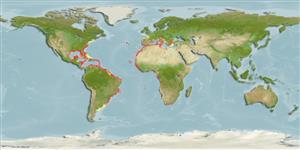
Western Atlantic: North Carolina, USA and northern Gulf of Mexico (Ref. 7251) through the Caribbean to Brazil. Eastern Atlantic: France to Angola and including the Mediterranean, Azores, Madeira, Canary Islands, Cape Verde and Sao Tome Island.
Dimensione / Peso / Età
Maturità: Lm ? range ? - ? cm
Max length : 38.0 cm TL maschio/sesso non determinato; (Ref. 7251); common length : 20.0 cm TL maschio/sesso non determinato; (Ref. 2683); Età massima riportata: 8 anni (Ref. 4742)
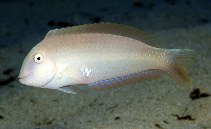
Spine dorsali (totale) : 9; Raggi dorsali molli (totale) : 12; Spine anali: 3; Raggi anali molli: 12. An elongate, very compressed fish with front of head forming a sharp edge. Snout very blunt; profile steep. Pale greenish, usually with no conspicuous markings on body (Ref. 26938). Head with alternating vertical lines of light blue and light yellow-orange (Ref. 13442).
Body shape (shape guide): elongated.
Inhabits clear shallow areas with sandy bottoms, usually in the vicinity of seagrass beds and corals (Ref. 2683). Feeds mainly on mollusks; also crabs and shrimps (Ref. 3726). A protogynous hermaphrodite; sexual dimorphism apparent in head shape and length of pelvic fin (Ref. 5292). Builds nests with coral debris. Dives head first into the sand when frightened (Ref. 9710). Marketed fresh (Ref. 3726).
Ciclo vitale e comportamento di accoppiamento
Maturità | Riproduzione | Deposizione | Uova | Fecondità | Larve
Gomon, M.F. and P. Forsyth, 1990. Labridae. p. 868-882. In J.C. Quero, J.C. Hureau, C. Karrer, A. Post and L. Saldanha (eds.) Check-list of the fishes of the eastern tropical Atlantic (CLOFETA). JNICT, Lisbon, SEI, Paris; and UNESCO, Paris. Vol. 2. (Ref. 5292)
Stato della Lista Rossa IUCN (Ref. 130435: Version 2025-2 (Global))
Minaccia per l'uomo
Harmless
Usi umani
Pesca: scarso interesse commerciale; Pesce da pesca sportiva: si; Acquario: Commerciale
Strumenti
Rapporti speciali
Scarica XML
Fonti Internet
Stime basate su modelli
Temperatura preferita (Fonte Biblio.
123201): 17.4 - 27.9, mean 24.4 °C (based on 858 cells).
Indice di diversità filogenetica (Fonte Biblio.
82804): PD
50 = 0.5005 [Uniqueness, from 0.5 = low to 2.0 = high].
Bayesian length-weight: a=0.00955 (0.00678 - 0.01346), b=3.00 (2.90 - 3.10), in cm total length, based on LWR estimates for this species (Ref.
93245).
Livello trofico (Fonte Biblio.
69278): 3.5 ±0.1 se; based on diet studies.
Generation time: 4.2 ( na - na) years. Estimated as median ln(3)/K based on 2
growth studies.
Resilienza (Fonte Biblio.
120179): Medio, tempo minimo di raddoppiamento della popolazione 1.4 - 4.4 anni (tmax=8).
Vulnerabilità della pesca (Ref.
59153): Moderate vulnerability (36 of 100).
🛈
Nutrienti (Ref.
124155): Calcium = 32.8 [14.9, 67.1] mg/100g; Iron = 0.522 [0.286, 1.082] mg/100g; Protein = 18.8 [15.9, 21.0] %; Omega3 = 0.142 [0.077, 0.259] g/100g; Selenium = 18.7 [8.5, 39.1] μg/100g; VitaminA = 56.4 [15.9, 255.3] μg/100g; Zinc = 0.892 [0.550, 1.509] mg/100g (wet weight);