>
Acropomatiformes (Oceanic basses) >
Lateolabracidae (Asian seaperches)
Etymology: Lateolabrax: Greek, latos, a fish of the Nile + Greek, labrax, -akos = a fish (Dicentrarchus labrax) (Ref. 45335).
More on author: Cuvier.
Taxonomic Remarks
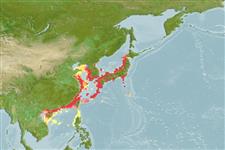
Junior synonym Lateolabrax maculatus considered as a valid species reported to be widely distributed (Japan, only in the Ariake Sea and off Nagasaki; China (off all coasts), Taiwan, and Korea (usually off the southern and western coasts) (Ref. 118669)
Lingkungan: lingkungan / zona iklim / kisaran kedalaman / jangkauan distribusi
Ekologi
laut; air tawar; payau berasosiasi dengan karang; katadromus (ruaya dari air tawar ke laut) (Ref. 36558); kisaran kedalaman 5 - ? m. Subtropical; 44°N - 15°N, 106°E - 143°E
Western Pacific: Japan to the South China Sea.
Panjang pada saat jatuh tempo pertama / Ukuran / Berat / umur
Kematangan: Lm ?, range 50 - ? cm
Max length : 102 cm TL jantan/; (Ref. 40637); common length : 16.1 cm SL jantan/; (Ref. 35840); Berat maksimum terpublikasi: 8.7 kg (Ref. 40637)
deskripsi pendek
Kunci identifiaksi (pengenalan) | Morfologi | Morfometrik
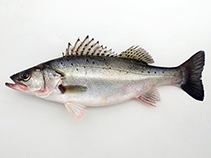
Duri punggung (Keseluruhan (total)) : 12 - 15; duri punggung lunak (Keseluruhan (total)) : 12 - 14; Duri dubur: 3; Sirip dubur lunak: 7 - 9.
Body shape (shape guide): fusiform / normal.
Found in moving water of inshore rocky reefs. Juveniles may ascend rivers and return to sea to spawn. Protandrous, sex change happens after maturation at age 2 (Ref. 36558). Spawning occurs during winter, in deeper rocky reefs or inshore areas. Predaceous, feeding on zooplankton at an early age and on small fish and shrimps as adults (Ref. 12497). Utilized as a food fish (Ref. 559). Family placement uncertain (Ref. 1830). Used in Chinese medicine (Ref. 12166).
Males mature at age 2 years, becoming females when older (Ref. 36558). Juveniles may ascend rivers migrating to the sea to spawn (Ref. 36558).
Paxton, J.R., D.F. Hoese, G.R. Allen and J.E. Hanley, 1989. Pisces. Petromyzontidae to Carangidae. Zoological Catalogue of Australia, Vol. 7. Australian Government Publishing Service, Canberra, 665 p. (Ref. 7300)
Status IUCN Red List (Ref. 130435: Version 2025-2 (Global))
ancaman kepada manusia
Harmless
penggunaan manusia
Perikanan: komersial; Budidaya air: komersial; Ikan buruan: ya
Alat, peralatan
laporan khas
muat turun XML
Sumber internet
Estimasi berdasarkan model
Suhu yang disukai (Acuan
123201): 12.7 - 26.3, mean 22.4 °C (based on 180 cells).
Indeks keanekaragaman filogenetik (Acuan
82804): PD
50 = 1.0000 [Uniqueness, from 0.5 = low to 2.0 = high].
Bayesian length-weight: a=0.01259 (0.00883 - 0.01795), b=3.02 (2.92 - 3.12), in cm total length, based on LWR estimates for this species (Ref.
93245).
Tingkat Trofik (Acuan
69278): 3.1 ±0.3 se; based on diet studies.
Daya lenting (Acuan
120179): sedang, Waktu penggandaan populasi minimum 1.4 - 4.4 tahun (K=0.14-0.2; tm=2; Fec=1,726,242).
Kerentanan Penangkapan Ikan (Ref.
59153): Moderate to high vulnerability (52 of 100).
🛈
Kerentanan Iklim (Ref.
125649): Moderate to high vulnerability (54 of 100).
🛈
Nutrisi (Ref.
124155): Calcium = 16.5 [8.1, 32.0] mg/100g; Iron = 0.471 [0.277, 0.738] mg/100g; Protein = 20.1 [19.0, 21.0] %; Omega3 = 0.212 [0.131, 0.340] g/100g; Selenium = 24.4 [12.4, 44.2] μg/100g; VitaminA = 24.7 [8.1, 76.3] μg/100g; Zinc = 0.756 [0.525, 1.096] mg/100g (wet weight); based on
nutrient studies.