>
Gobiiformes (Gobies) >
Gobiidae (Gobies) > Sicydiinae
Etymology: Stiphodon: Greek, stiphos, -eos, -oys = mass + Greek, odous = teeth (Ref. 45335).
Environnement : milieu / zone climatique / profondeur / gamme de distribution
Écologie
; eau douce démersal; amphidrome; profondeur ? - 5 m (Ref. 86942). Tropical
Asia and Oceania: occurs in Indonesia, on the northern coast of New Guinea, Admiralty Islands, Halmahera Island, Bismark Archipelago, Bougainville, Vanuatu and New Caledonia (Ref. 87781).
Taille / Poids / Âge
Maturité: Lm ? range ? - ? cm
Max length : 6.0 cm SL mâle / non sexé; (Ref. 26040); 4.2 cm SL (female)
Description synthétique
Clés d'identification | Morphologie | Morphométrie
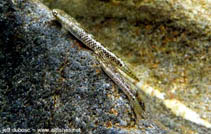
Second dorsal fin with 9 segmented rays; usually 15 pectoral fin rays; lateral scales extend dorsal to pectoral base, usually 33-36; belly scaled close to pelvic disc; males with first dorsal fin higher than second dorsal fin, spines not filamentous; predorsal midline with 9-17 cycloid scales; males blackish, 5 or 6 bars between second dorsal and anal fins; and females with midlateral band straight with blotchy patches on caudal peduncle.
Body shape (shape guide): elongated.
The species is found in coastal steams, in clear and oxygen rich water, in the lower course of rivers, up to 50 m in altitude. It prefers rocky substrates, with boulders and pebbles, and slow to medium currents (pools). It feeds on algae and small invertebrates, scraping them of the surface of the rocks. The species is amphidromous. After the reproduction in freshwater, larvae go at sea where they undergo a planktonic life for several months (Ref. 87781). Inhabits large and quite streams, preferring pools and backwater areas. (Ref. 26040).
Cycle de vie et comportement reproducteur
Maturité | Reproduction | Frai | Œufs | Fécondité | Larves
Watson, R.E., 1996. A review of Stiphodon from New Guinea and adjacent regions, with descriptions of five new species (Teleostei: Gobiidae: Sicydiinae). Rev. Fr. Aquariol. 23(3-4):113-132. (Ref. 26040)
Statut dans la liste rouge de l'IUCN (Ref. 130435: Version 2025-2 (Global))
Menace pour l'homme
Harmless
Utilisations par l'homme
Pêcheries: sans intérêt
Outils
Articles particuliers
Télécharger en XML
Sources Internet
Estimations basées sur des modèles
Indice de diversité phylogénétique (Réf.
82804): PD
50 = 0.5000 [Uniqueness, from 0.5 = low to 2.0 = high].
Bayesian length-weight: a=0.00389 (0.00180 - 0.00842), b=3.12 (2.94 - 3.30), in cm total length, based on all LWR estimates for this body shape (Ref.
93245).
Résilience (Réf.
120179): Haut, temps minimum de doublement de population inférieur à 15 mois (Preliminary K or Fecundity.).
Vulnérabilité de la pêche (Ref.
59153): Low vulnerability (10 of 100).
🛈