>
Salmoniformes (Salmons) >
Salmonidae (Salmonids) > Thymallinae
Etymology: Thymallus: Greek, thymallos, -ou = a kind of fish similar to salmon (Ref. 45335); thymallus: The name 'thymallus' could come from the thyme taste of the flesh of this fish (Ref. 30578).
More on author: Linnaeus.
Περιβάλλον: περιβάλλον / κλιματική ζώνη / εύρος βάθους / εύρος διανομής
Οικολογία
; Γλυκού νερού; Υφάλμυρο βενθοπελαγικό; pH range: 7.0 - 7.5; dH range: 20 - ?; μη μεταναστευτικό(ά); εύρος βάθους 15 - ? m (Ref. 30578). Temperate; 6°C - 18°C (Ref. 2059); 70°N - 42°N, 6°W - 66°E
Europe: Barent Sea basin west of Urals, Caspian, Black, Baltic, White and North Sea basins, Atlantic westward to Loire drainage; Rhône drainage; northern Adriatic basin east to Soca drainage. Introduced over most of southern and central Finland.
Μήκος κατά την πρώτη ωρίμανση / Μέγεθος / Βάρος / Ηλικία
Γεννητική Ωρίμανση: Lm ? range ? - ? cm
Max length : 60.0 cm TL αρσενικό/απροσδιόριστο; (Ref. 556); common length : 30.0 cm TL αρσενικό/απροσδιόριστο; (Ref. 556); μεγ. δημοσιευμένο βάρος: 6.7 kg (Ref. 6368); μεγ. αναφερόμενη ηλικία: 14 έτη (Ref. 556)
Σύντομη περιγραφή
Κλείδες προσδιορισμού | Μορφολογία | Μορφομετρία
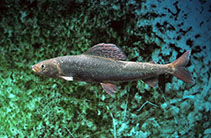
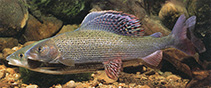
Ραχιαίες άκανθες (συνολικά) : 5 - 8; Μαλακές ραχιαίες ακτίνες (συνολικά) : 12 - 17; Εδρικές άκανθες: 3 - 4; Μαλακές εδρικές ακτίνες: 9 - 10; Σπόνδυλοι: 57 - 61. Distinguished from Thymallus arcticus by the following unique characters: maxillary usually reaching anterior margin of eye; pelvic fin grey, lacking red stripes; body without red spots; dorsal fin greyish, with parallel rows of round dark spots; gill rakers 19-30, averaging about 24-26 (Ref. 59043). Caudal fin with 19 to 21 rays (Ref. 2196).
Body shape (shape guide): fusiform / normal.
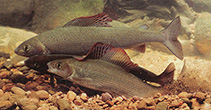
Inhabits submontane reaches of rivers with a hard sand or stone bottom and well oxygenated, cold and fast-flowing water (Ref. 59043). Prefers running, well-oxygenated waters of rivers (Ref. 30578). In Scandinavia, it occurs in clear lakes and freshened part of northern Baltic basin. Usually lives in hollows behind boulders and shaded water under overhanging vegetation (Ref. 59043). Gregarious, forms schools (Ref. 2196). Feeds mainly on insects (Ref. 9696), nymphs, small worms and crustaceans (Ref. 30578). Breeds in shallow stretches, usually 20-40 cm deep, or riffles, with moderate current of about 0.5 m/s and clean gravel bottom (Ref. 59043). Can be captured with natural bait (insect larvae) or with artificial fly. Very sensitive to pollution (Ref. 30578).
Kottelat, M. and J. Freyhof, 2007. Handbook of European freshwater fishes. Publications Kottelat, Cornol and Freyhof, Berlin. 646 pp. (Ref. 59043)
Κατάσταση Κόκκινου Καταλόγου IUCN (Ref. 130435: Version 2025-2 (Global))
Απειλή για τον άνθρωπο
Harmless
Ανθρώπινες χρήσεις
αλιεία: Εμπορικό(ά); Υδατοκαλλιέργειες: Εμπορικό(ά); αλιεία αναψυχής: ναί; Ενυδρείο: Δημόσια ενυδρεία
Εργαλεία
Ειδικές εκθέσεις
Λήψη XML
Διαδικτυακές πηγές
Εκτιμήσεις βάσει μοντέλων
Δείκτης φυλογενετικής ποικιλότητας (Αναφ.
82804): PD
50 = 0.5000 [Uniqueness, from 0.5 = low to 2.0 = high].
Bayesian length-weight: a=0.00741 (0.00562 - 0.00978), b=3.07 (2.99 - 3.15), in cm total length, based on LWR estimates for this species (Ref.
93245).
Τροφικό Επίπεδο (Αναφ.
69278): 3.1 ±0.42 se; based on food items.
Generation time: 5.1 (3.1 - 7.8) years. Estimated as median ln(3)/K based on 13
growth studies.
Ελαστικότητα (Αναφ.
120179): Μεσαίο(α), ελάχιστος χρόνος για διπλασιασμό πληθυσμού 1,4 - 4,4 έτη (K=0.12-0.26; tm=2-6; tmax=14).
Ευπάθεια στην αλιεία (Ref.
59153): High vulnerability (56 of 100).
🛈
Θρεπτικά συστατικά (Ref.
124155): Calcium = 37.9 [10.2, 95.2] mg/100g; Iron = 0.57 [0.18, 1.25] mg/100g; Protein = 18.2 [16.5, 20.0] %; Omega3 = 1.06 [0.46, 2.76] g/100g; Selenium = 38.8 [12.2, 126.8] μg/100g; VitaminA = 15.6 [5.1, 45.3] μg/100g; Zinc = 0.722 [0.386, 1.346] mg/100g (wet weight); based on
nutrient studies.